So many authors writing across languages and cultures point to Julia Alvarez’s debut novel, How the García Girls Lost Their Accents, as one of their ancestors. In this episode, we hear from Alvarez about the importance of defending all kinds of stories—and why the American cannon needs to be exploded.
Want to learn more about the topics brought up in this episode? Check out the following links:
- How many books have you read? Check out BPL’s full list of 250 books that influenced America. Then check out our booklist with all the titles Julia mentioned in this episode.
- Read an interview with Julia Alvarez about the banning of García Girls in Johnston County, NC.
- Want more interviews with authors on BPL’s 250 for 250 list? Check out the following interviews: Edwidge Danticat, Breath, Eyes, Memory; Jacqueline Woodson, This Is the Rope; Jose Antonio Vargas, Dear America; Maia Kobabe, Gender Queer; Roxanne Dunbar-Ortiz, An Indigenous Peoples’ History of the United States; Art Spiegelman, Maus; N.K. Jemisin, The Fifth Season; George M. Johnson, All Boys Aren’t Blue
Check out our booklist with books recommended for this episode.
Episode Transcript
Transcript
Julia Alvarez I am Julia Alvarez. If I cross the border, I'm Júlia Alvarez. And I'm a writer, I think sometimes I don't want to give myself too highfalutin a title and set the bar too high… I'm a storyteller.
Adwoa Adusei Julia Alvarez almost needs no introduction. She’s the author of eight novels, three books of nonfiction, five collections of poetry, and twelve books for children and young adults. Her most well-known book is How the García Girls Lost Their Accents, and it came out in 1991.
Virginia Marshall It’s the story of four García sisters who came to New York City from the Dominican Republic when they’re young. The novel is inspired by Alvarez’s own experience fleeing Trujillo’s dictatorship when she was ten years old.
Adwoa Adusei It wasn’t easy being a refugee in a new country, learning a new language and a new culture. But Alvarez said that she wouldn’t be a writer today if she hadn’t made that journey, if she hadn’t had to start a new life in the United States.
Julia Alvarez I was raised in the 1950s in a dictatorship in a really traditional family where there was no… higher education, what we call higher education, a girl went through high school, that was considered her higher education. And most married young and started their families. That was what I saw around me. I didn't see any readers. I didn't see professional women or anything of the sort. So, I didn't see those possibilities out there, but I felt a yearning in me.
So, probably if I had stayed there, I would have led a traditional life. But I think coming into English, having to learn the language intentionally, which even for my native speakers of English in my writing workshops, I would say as a writer, you have to re-learn the language. Because you learn it intuitively, instinctively, that’s nice. But as a writer you then begin to say, is this the right word? Is this exactly—is this the cadence I want? So you have to re-learn it. And I was doing that as I was learning English as a 10-year-old.
Virginia Marshall For Julia Alvarez, bilingualism was a kind of superpower. It allowed her to look at the English language from the outside, and it allowed her to be creative, to import from each language as necessary, moving between the two to create new worlds in her stories.
Adwoa Adusei So many writers—many also writing across languages and cultures—point to Alvarez as one of their ancestors. She paved the way. And that’s why her book is on BPL’s list of 250 books that influenced this country.
Virginia Marshall Today, we get to hear from the great Julia Alvarez herself about the books that influenced her … and what she sees as the future of literature in the United States. I’m Virginia Marshall.
Adwoa Adusei And I’m Adwoa Adusei. You’re listening to Borrowed & Returned: revisiting the books that changed us, and changed America, too.
[Music]
Adwoa Adusei How the García Girls Lost Their Accents is a book told in reverse. The novel starts at the end, in 1989, with the sisters visiting the Dominican Republic again as adults. They’re with their cousins and Tias, and there's a cake in the shape of the island to welcome them home. When Yolanda—the third oldest sister—blows out the candles, she makes a wish: “Let this turn out to be my home.”
Virginia Marshall As readers, we’re left wondering if Yolanda is going to move back to the DR. It’s a really striking opening because the novel doesn’t answer that question. Instead, the narrative goes back in time until the four sisters are little girls about to flee the Dominican Republic for the first time. When we sat down with Alvarez, we started by asking her this question: Why start the story at the end, in that place of limbo?
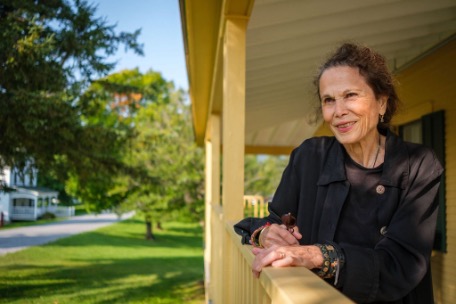
Photo Credit: Corey Hendrickson
Julia Alvarez I didn't want just a traditional, you know, growing up chronological, you know, coming of age, leaving, becoming an adult… I wanted the structure of the novel to reflect the thinking of someone that has come to another country as a refugee. You're always going back. You're always going back. You're always thinking back. You know, I remember when we first arrived, I would say, I wonder what my cousins are doing right now. I wonder if tía is now in the kitchen making arroz con pollo… I wonder, I wonder. There's always this pull, kind of like the tide pulling you back. And I wanted the narrative structure to reflect that so that in reading the novel, the reader becomes themselves immigrants, you know, immigrants thinking like one, not just reading about them. Not just external. So that was that decision too, but it is very much, you know, something that happens and when you come from somewhere else. There's a root system somewhere else. And you go back periodically to it, even if only in imagination, only in your memories, only in thinking. You need nourishment from there. You can't cut yourself off.
You know, it was implanted in my head that it was either / or. You were either Americana or you were Dominicana. You either were speaking in English and cut off your ties to the past—this was the old model—or you were Dominicana and you could never really settle in this country. um So that this either / or, I think, was imprecise to the inner experience, you know, that you had to choose. It would have been easier because it would become this or that. And there would be no confusion. There would be no gray area. There would be no struggle. There would be no story. Because stories are born in that roil, you know, in that world of those gray areas.
Adwoa Adusei You've said that part of the gap you were trying to fill and when you set out to write García Girls was the lack of the “immigrant story” from a female perspective. And the book came out in 1991. And now that, you know, 30 years have passed, how do you think the canon of American immigrant literature has changed? And what gaps do we still have to fill?
Julia Alvarez Huge gaps When I wrote García Girls, as I said, there were some immigrant stories, Piri Thomas, Edward Rivera, Oscar Hijuelos, all from male perspective points of view. And I wanted to know, well, what was the story from a female—not just point of view, but a female body, you know, a female surrounded by all kinds of layers of patriarchy.
Canons, I think canons, like their homonyms, are made to be exploded. You know, canons are problematic for me. I think they're a way to colonize literature and create, you know, kind of the imperial stamps of approval, even on those that are lucky to be let in, like a Maxine Hong Kingston, like my book on several lists. But I think they're—we make them, we rank them, just like we say, these are my favorite foods, these are my favorite people. But we have to do that with a sense of, you know, irony and knowing that it's shifting. These are the ones that are speaking to us right now, but there's a big sea.
Virginia Marshall That's great. I think I'll think about that for a long time. The canon, like its homonym, is meant to be exploded. That was great. I actually want to shift and talk to you a little bit about censorship. It's something that Brooklyn Public Library has been really aware of, especially with the uptick in book bans in the last few years. And I know How the García Girls Lost Their Accents was banned in Johnston County, North Carolina back in 2007, maybe other times as well …
Julia Alvarez In Florida, there was a suit by my publisher along with several other authors. Yes.
Virginia Marshall Wow. And that was more recent, then, in Florida?
Julia Alvarez Yes, that was several years ago.
Virginia Marshall Wow. Yeah. I think they often point to a scene with Carla when she's young, and she has an experience with a pedophile where he flashes her. And it's actually this really emotional moment when I was reading it, I was emotional because she has to then retell her experience in English, a language that she's just learning. And it's this kind of moment of like, a young girl not being able to speak what has happened to her for many reasons. So I think it's very important to read something like that. But I'm wondering for you, like, what is your reaction when you hear, you know, the scene being pulled out of context, or even hear that your book is being banned?
Julia Alvarez Well, you know, I often find that the book has not been read, and something has been taken out of context. And ironically, that is a scene people focus on, which is a scene so much about not having language to express something that it has been horrific to the little girl. She doesn't have a way to say it. And she's mute, like that wonderful YA novel Speak—you know, she can't speak it. And then for censorship to come, and people not wanting this story to speak this reality is just like a double bounding and gagging.
And you speak of that, yeah, that Johnston County… and it was the librarians there who invited me down for a town meeting with the parents who were agitating that this novel be banned. And I thought, oh, I don't want to go face those people. And then I thought, these librarians are doing it. Come on. And so I went down there. We have this town meeting. And I got up and I talked passionately about literature and how literature is a safe space. It allows us to experience all kinds of reality. But in a great book that has a moral imagination, we have the chance to experience these moments. And then when they really happen, we have an enlarged capacity for compassion and understanding. Blah, blah, blah. I went on and on. Then the Q&A started. And this one woman that really touched me, she got up. She was red-faced. I could tell that this was very difficult for her to be a public speaker. She had her little handbag in the crook of her elbow. And she said in a trembly voice, “I have to tell you, I'm very sure that you have written a classic.” And I thought, well, she didn't read the book, for sure. Okay, of course. But she said, “But you have to understand, our children are living in such a confusing world where, you know, there is no clear, this is black and white, wrong and right. And they need that. They don't need all this gray area.” And I got it. I said, “You know, you're right. Not that they don't need it, but literature is all about the gray areas.”
Virginia Marshall Yeah, yeah. And it makes me think too, I know, you grew up partially in a dictatorship, as you mentioned earlier. And I wonder if you have anything more to share, any other wisdom about where we find ourselves now in relation, I guess, to like more and more book bans happening, particularly, you know, LGBTQ+ books and BIPOC books. Is there any kind of comparison that you make yourself between…?
Julia Alvarez Oh, absolutely. There has always been censorship. I mean, as we celebrate the 250 of America, you know, yeah yes, cause for celebration, but not for fooling ourselves that this is a culture and a country that has a problematic history. That doesn't mean you don't love it. People are flawed, countries are flawed, but the censorship now is deeply troubling. The dictatorship that is going on in many areas of the law, in our government, in the White House, that is deeply troubling. It's, you know, we who grew up in so-called “banana republics,” and who came from underdeveloped countries, we can read that. We don't fool ourselves, what we're seeing.
And I think some of the censorship now is so blatant that it's even more shocking maybe, because there's no denying that it's going on. There were other forms of subtle censorship when writers of color, of other ethnicities were not being published. That's a kind of censoring and monitoring that was systemic. But now it's, I mean, you can't not see it. It's out there. And so it is troubling. All the more reason that, you know, literature that keeps refusing to close the door and shutter the windows is ever the more a place we need to protect and maybe that's the real celebration.
Adwoa Adusei Thank you for bringing up 250 years of American history, that elides into our next question about the book list, right, that BPL created. And we wanted to know from you, is there a book on the 250 list that influenced you? And could you tell us a little bit more about why?
Julia Alvarez So many. I mean, I could, you know, when once I went down the list, I said, oh, this is not, this is not going to be easy. The kid in the candy shop, so many of them that it was difficult to pick. But because García Girls was the focus and because it was the first novel, characters, two real muses of that novel. The first one is the first novel that I read in English, because later I would love Jane Austen and so forth, but those were too hard for me. But one of the first novels that I became totally immersed in, and you can imagine why, was Little Women by Louisa May Alcott, Four sisters, one a storyteller. The father was, you know, off to war, in danger of his life. We had come from a dictatorship. My father had been a dissident. The danger of his life was always something we were worried about. But we were an all-girl, all-women family. And get this, the names even reflected our family. There was Meg, Margaret, Mauricia, my older sister. There was Jo, there was Julia. Elizabeth, there was Estela, E. And there was Amy, there was Anna, A. And my mother claimed she had never read that book. And we thought, really? Are you sure? But it gave us goosebumps. It was our story, translated into an American family.
Virginia Marshall That’s amazing.
Julia Alvarez So just that, and the fact that there was a storyteller, a plucky girl, you know, a Scheherazade, because that was my first hero in the Dominican Republic, in the Arabian Nights. This young girl who tells stories and saves the kingdom and the women in the kingdom. I loved her. Here was another. She saved her family. She was earning money. She was strong. She presented another possibility besides the romantic plot. She didn't marry, what was his name?
Adwoa Adusei Laurie?
Julia Alvarez Yeah, Laurie. She went out there. And then I read The Woman Warrior. Oh my goodness. I think it came out ‘76 or so, 1976. I was in my twenties. Yeah. And I thought, wow. It was a Chinese-American family in Sacramento, California. We were a Dominican family in Queens, but it might as well have been my family. I mean, the confusing mixture of cultures, the languages, a woman warrior again, through story. The oral culture, because they call it called “talk story.” That’s what I grew up with. All of that. But the first line—I often joked to my Latina friends of my generation, Latina writer friends, that that sentence could have been the invisible sentence opening any of our novels: “My mother told me never ever to repeat this story.” That was also there. And so I just, I thought, this is a beautiful book. And lo and behold, soon it was being lauded left and right. I thought, oh, yes, yes. And it was also, you know, to use the Toni Morrison phrase, it was also not writing for the white gaze. for the assimilated gaze, it had all its complexity, all the richness and strangeness of the culture. It wasn't performing the culture for a reader that was on the outside. It just threw you in there.
Virginia Marshall Wonderful. I want to talk to you a little bit about your language and poetry, actually. You have said that poetry in English, the rhythm of it, reminds you of the Spanish language. And you've also said that you're speaking your Spanish voice in English when you're writing poetry. And that just kind of was amazing to me. So I wonder if you could say more about how that works, and also maybe what happens in your head when you're writing prose instead of poetry.
Julia Alvarez Well, I think poetry, when I first came into English, that was my first love. I think it was a way, its musicality—because what we read in our little anthologies were rhymed, metered verse. And so its musicality, its rhythms reminded me of Spanish. It was a way that I could speak my Spanish in English. It was a connection. And it was my first love, because in our oral culture, we memorized poems. The first poem in my latest collection is called “Recitation.” And it recalls those moments in childhood when we would be brought out to my mother's friends to recite poetry. And so there was also that connection to poetry.
Honestly, I try to get some of that into my writing of prose. Often when I close a section or a chapter, I'll find that I'm echoing a word three sentences before that brings a kind of sonar closure to what's happening to the plot. I was giving a reading in New York at the Y, and the Q&A there—I think I was promoting In the Time of the Butterflies—a man got up towards the end and said, “When are you going to write shorter sentences?”
Virginia Marshall That's hilarious.
Julia Alvarez I hadn't even thought about it. I went back to my hotel room, and my book tour book that I brought along because it was a slim volume, was Raymond Carver's Will You Please Be Quiet, Please? And I read, and what I did was I took a page and I counted the number of words in that sentence and then I graphed it, you know. And he had: 10, 7, 13, 7, 2, 18, big sentence! Then I did one from In the Time of the Butterflies, and I had 36, 78, 15…. and I thought, oh, that's… we bring our syntaxes with us. I mean, I read Julie Otsuka or I read Maxine Kingston, and I hear a different syntax to English. A different—it's like a slight accent in the way that it moves. And that infuses and enriches the language, our wonderful American English that is just a messy language. I mean, it's just got fusions from everywhere, you know. Whitman called it the “barbaric yawp” of English. And it is, but I love that.
Virginia Marshall Right, and you're part of that, too. Like, your voice is part of that.
Julia Alvarez Yeah, yeah. My long sentences.
Virginia Marshall [Laughs] Yeah, exactly. Yeah, that's great. I actually have a question about how you've inspired other bilingual writers. So I was reading the introduction to your 30th anniversary edition of the García Girls, and it was written by Elizabeth Acevedo, whose book The Poet X is actually also on our 250 list.
Julia Alvarez That was one of the ones I was going to pick!
Virginia Marshall Oh, well now you can talk about her. So, she said in the introduction that reading your book was the first time she'd ever read a book in which Dominican characters were centered. She later purchased a Spanish language translation of the book so that she and her mom could read it together. She said your book changed her, you know. And so I just wanted to ask, you know, how have you seen the impact your book has had on its readers?
Julia Alvarez I mean, any reader. And it's not readers in the plural, it's always this one. This one, you know, that it's touched bottom in the imagination of another, of a listener. You know, that's really what we work for. You know, the plurals become overwhelming, you know, “readers.” But that Liz said that. And the fact that, yes, there's such talent out there. Liz Acevedo. Angie Cruz, Nelly Rosario, you know, Loida Maritza Pérez. There's so many wonderful writers coming. Junot Diaz, you know. And I got it from Maxine. I got it from Louisa May Alcott. I got it from Scheherazade. It wasn't original with me. If I stop it there, I stop the circulation and the flow. It is the sea that we’re feeding, after all.
Virginia Marshall That's great. Thank you.
Julia Alvarez Well, thank you for doing this. I mean, as I said, libraries—I'm sure you hear this from so many writers that it feels like just a rubber stamp—but it is sincere and heartfelt that libraries were so important. I mean, they still are to me. I’m still a huge user of our local library here in a small town in Vermont. But to go into the cathedrals of literature, as I thought of libraries, and be able to to move in those spaces are so critical. So, that they exist, that you all exist, and that you keep the doors open, and that you don't take things off the shelf. You're freedom fighters, you know, you really are.
Virginia Marshall Borrowed & Returned is a production of Brooklyn Public Library. It’s written and produced by me, Virginia Marshall, and co-hosted with Adwoa Adusei. Our Borrowed team is made up of Fritzi Bodenheimer, Robin Lester Kenton, and Damaris Olivo. Jennifer Proffitt and Ashley Gill run our social media. Laurie Elvove designed our logo. And Gregg Richards took the incredible photos of the authors you can see on our website and in your podcast app. Special thanks to 651 Arts, who let us record this episode in their studio.
Adwoa Adusei Brooklyn Public Library relies on the support of individuals for many of its most critical programs and services. To make a gift, please go to BKLYN Library [dot] org [slash] donate. You can read a transcript of this episode and our show notes at BKLYN Library [dot] org [slash] podcasts. We’ve put links to the books Julia Alvarez mentioned in this episode, so you can check them all out from Brooklyn Public Library.
Virginia Marshall Next week, we have an interview with Brooklynite and activist Linda Sarsour, whose memoir We Are Not Here to be Bystanders—made BPL’s list of 250 books that influenced America.