Celebrations of the nation’s 250th anniversary can feel like a party not everyone is invited to, especially for those whose immigration status is in limbo. In this episode, Haitian-American writer Edwidge Danticat talks about the impact of transnational migration has had on her writing, and the kind of party she wanted to throw for America’s 250th anniversary. (Hint: it has to do with books!)
Want to learn more about the topics brought up in this episode? Check out the following links:
- How many books have you read? Check out BPL’s full list of 250 books that influenced America. Then check out our booklist with all the titles Edwidge mentioned in this episode.
- Want more interviews with authors on BPL’s 250 for 250 list? Check out the following interviews: Jacqueline Woodson, This Is the Rope; Jose Antonio Vargas, Dear America; Maia Kobabe, Gender Queer; Roxanne Dunbar-Ortiz, An Indigenous Peoples’ History of the United States; Art Spiegelman, Maus; N.K. Jemisin, The Fifth Season; George M. Johnson, All Boys Aren’t Blue
Check out our booklist with books recommended for this episode.
Episode Transcript
Adwoa Adusei Edwidge Danticat is a Haitian-American writer based in Brooklyn and Miami. She’s the author of numerous novels, essay collections, books for children, and an award-winning memoir. Her debut novel—Breath, Eyes, Memory—came out in 1994, when she was just 24 years old.
Virginia Marshall In our last episode, the writer Jacqueline Woodson named Breath, Eyes, Memory as one of the books she was excited to see included on BPL’s list of 250 influential books. She spoke about Edwidge’s lyrical prose, and her focus on questions of migration, inheritance, and identity. Edwidge herself has a more humble view of her own writing.
Edwidge Danticat I feel like I'm an accident of literacy. Like, if I had not been able to learn to read and write, I wouldn't be able to do any of this. I wouldn't be able to write my books. I wouldn't—so, the power of literacy itself is like the first layer of that, just being able to read and write.
Adwoa Adusei For her first novel, Edwidge wrote a story that mirrored her own experience of migration. Breath, Eyes, Memory is about three generations of women in Haiti and in Brooklyn. And there’s a lot of back-and-forth movement between the two places, a fluid coming and going.
Edwidge Danticat When I started writing Breath, Eyes, Memory, I was in the middle of that fluidity myself. We were in the midst of that kind of migration, and there were certain patterns for some of some Haitian immigrants, right, with the parents coming first. You had a person who went first. And for me even, it was the same. Once a week, I would go to a phone booth in downtown Port-au-Prince and talk to my parents. And so I think that was very important for me to express the realness of, like, the logistics, almost, of migration.
Virginia Marshall Since her first novel, Edwidge Danticat has written several books—novels, collections of essays, a memoir, and books for children. Today on Borrowed & Returned, Edwidge talks about her journey from oral storytelling to writing, and how migration has shaped her work. We also get to hear about her love of Brooklyn, and the kind of party she wanted to throw for the United States’s 250th anniversary. I’m Virginia Marshall.
Adwoa Adusei And I’m Adwoa Adusei. You’re listening to Borrowed & Returned: revisiting the books that changed us, and changed America, too.
[Music]
Virginia Marshall We spoke with Edwidge in late June, at a time when Haiti was in the news a lot. In fact, our interview happened to take place on the same day the Supreme Court ended Temporary Protected Status—or T.P.S.— for immigrants from Haiti and Syria. That decision puts hundreds of thousands of people at risk for deportation, many of whom have been in the United States for decades.
Adwoa Adusei At the same time, there was some cause for celebration… The Haitian national team was competing in the World Cup for the first time in over fifty years. So, we started the interview by asking Edwidge about her relationship with Haiti today, and with the United States.
Edwidge Danticat You know, Haiti is where my life began. I think there's a very different relationship to a place you don't choose to leave, right? Like, my parents made a very difficult decision to leave two small children behind and come to the U.S. for a better future for us. And, you know, them sending for me was not my choice. I don't know that I would make a different choice, but it wasn't, you know, just kind of like, you’ll hear Caribbean people my generation or younger say, “I was sent for.” So, I think in a way that deepened my attachment to Haiti. I still have a lot of family members there. And today's actually hard day in that middle place with America and Haiti, where the Supreme Court just made this decision to allow 350,000 to half a million people to lose their status, which means that those people can be deported. That just happened before we started talking. So, it's sort of like we live in those chasms. At the same time yesterday, we were, like, on a high celebrating Haiti.
Adwoa Adusei Right, yeah, the game.
Edwidge Danticat Yes, the game, right? Like even being in the World Cup. The last time it was in the ‘50s. And the fact that, you know, the team members who are children of migration, too—some of them born in France, some of them born in Canada. Only one in the selection. lives in Haiti and had trouble getting a visa here. That's, I mean, all of that to say that's sort of like the relationship that a lot of Haitians, like, I think the World Cup proved it, like how many people, two, three generations were wearing their flag, wearing their shirts, cheering for Haiti, this kind of rallying. So, my connection to Haiti is very, very deep. It's one of the places I call home. I also call America home. My children were born here. My parents are buried in Queens. And so I have a deep connection to both.
Virginia Marshall Yeah, thank you for that. And I want to actually talk a little bit more about Breath, Eyes, Memory, and Sophie, the main character there. I was struck by this moment where she comes to Brooklyn, and she's looking at Flatbush Avenue and it reminds her of home. She says that people there “seem displaced,” she says. And I was just thinking like that really reminds me of our whole city. You know, it's made up of these like thousand pieces of elsewhere. So I wonder if you could talk a little bit about your connection to Brooklyn and maybe what you wanted your characters to get out of their time in Brooklyn.
Edwidge Danticat Yeah, I mean, Brooklyn was the first place I arrived—Westbury Court, East Flatbush. And so I had so many crisp memories. And we lived in a building that was owned by the minister at the church that my parents attended. And every Sunday, we had potlucks in different homes. So it was just the sense of community in Flatbush which was very, very strong for me. The stretch of Brooklyn that I was most familiar with was between Clara Barton High School, which is very near to the Brooklyn Public Library, and I spent a lot of time at the library. And so I wanted Sophie as a character to have that experience.
And the idea of displacement too, I mean, at that time when I arrived in ‘81, there was still the dictatorship. It was Jean-Claude Duvalier, Baby Doc. And there were so many people who still were waiting for the dictatorship to end so they could go home—and then realized in the meantime that they had built this life here. So that sense of, I think, displacement that as a child she was picking up, I was also picking up. Just kind of like folks with T.P.S. today, until today, were kind of in limbo waiting to see what would come next in their lives.
Virginia Marshall Yeah, yeah, that makes a lot of sense. You did just mention the library, which I wanted to ask… so, what were you doing there when you were just coming to America, going to the library, were you reading there? What was that place for you at the time?
Edwidge Danticat Well, the first time I went to the main library, my dad was a taxi driver. So he took me on a Saturday to get a card. And I remember being very surprised that we were going to be entrusted… [Laughs] you did have to bring a light bill, so they knew your address. But I was really shocked that I was going to be entrusted with back then the limit was ten books. And my dad would just drive me on the weekends to the library. And I was just enamored. I thought it was so vast. This idea that you could just borrow a book and that you were entrusted with that. And I remember trying, you know, there were Haitian books, too. I started reading a lot of Haitian literature because there were a few shelves of Haitian novels in French. I didn't read in English then. I started, I picked up a copy of Maya Angelou's I Know Why the Caged Bird Sings there. And that was the first book I read in English. So I really, I felt very welcomed and indulged by the library. I felt like, oh my gosh, this is—I felt like it was just for me, frankly.
Adwoa Adusei You mentioned that you were able to pick up Haitian books. Were they in Haitian Creole? In French?
Edwidge Danticat No, they were in French. So I remember very vividly, they were—they had names that everybody Haitian would recognize from Haitian literature: Jacques Roumain, Jacques Stephan Alexis, Marie Chauvin. And then they had also some of the contemporary writers who were living in Canada at the time, like Dany Laferrière, Jean Métellus. Liv Ayisyen, Haitian books—and they were all in French.
Virginia Marshall Edwidge said that when she started writing, there were many other Haitian novels to look to for inspiration. But her book was unique in the way it approached taboo topics like rape and abuse. In particular, she wrote about the practice in Sophie’s family of mothers “testing” their daughters to see if they were still virgins. That test was physical and traumatizing.
Edwidge Danticat Well, when the book first came out, I mean… the reaction was, you know, it was mixed. I remember going to readings where people were like, “You are making people think that this happens to all of us.” You know, like the testing. And you know people who are more privileged Haitians who are like, “I don't recognize the story at all.” They're kind of like, “You know, you're selling your people out for money.” All kinds of things… a bit overwhelming for a 24-year old. I’m glad there was no internet then. But it was a mixed reaction, frankly.
Virginia Marshall Yeah, yeah. And I'm just reminded that you were so young when that book came out. I had a question actually for you along these lines about inherited trauma. It's like a term that we talk about now, I think, but I wonder in 1994 when the book came out, was that kind of language that you had access to? That you could use to talk about what you were writing about? Or, how did you talk about it, I guess?
Edwidge Danticat Well, I didn't have the idea of inherited trauma, like the way we have generational trauma. I think I'd read some Alice Walker, I'd read The Color Purple. And again, having read Maya Angelou's I Know Why the Caged Bird Sings, I felt really like that book gave me permission to write this book, Breath, Eyes, Memory. Because she wrote so well about her own personal trauma. And I did read about sort of, self-healing with trauma. I think I read a couple of books like that moment of the women coming together with their own rituals to try to heal themselves—was informed by. But I definitely was trying to better understand how we can heal trauma. I didn't want to just write a book in which someone is traumatized by members of their own family who are just doing what they were taught, what they believe is right.
Adwoa Adusei You mentioned healing, and we wanted to talk about the power of writing in the book. There's a really interesting conflict with the grandmother, a tension between written words and oral stories. So, grandma tells the stories to the neighborhood kids, which she then announces with, “Krik, Krak.” I'm not sure if I'm pronouncing that right…?
Edwidge Danticat Krik Krak. [Laughs]
Adwoa Adusei Krik Krak… A lovely book. I love that book also. Was that a tension you witnessed in Haiti, between oral tradition and sort of written word?
Edwidge Danticat Well, I think it's a tension that lives in me. Because I grew up in that situation with elders who told stories all the time. And most of them, the elders who told me stories, they did not know how to read or write. So the story was sort of embedded in them, and they told it differently every time. They told it in a very lively way. And then I realized when I was in those sessions, I was like—that's not me. Like, I was a very shy child. I was not, I just, I would never be able to do that. But I just remember when I got a book—which my uncle gave me Madeline in French, that book. And when I got that book, I was like, oh, this is another way of telling stories. And I can do that. And then you can access… you don't have to drag the person out every time, you can just access the story in a book! But the difference, too, is that when you have someone telling a lively story, the connection is so strong between the audience, like theater, right? But even more so, because in these storytellings, if they noticed that the kids were falling asleep, they would put a song, there would be like this engagement, like this connection with the audience.
Adwoa Adusei Are there ways that you try to preserve or utilize oral storytelling within your own writing?
Edwidge Danticat Yes, I try to. I think probably the most direct way is that I read out loud everything that I write. And so I record it so I can hear it. And it's a two step in the sense that when you're reading it, if you stumble on things, if they just don't sound so natural, you can catch a bunch of things. And then when you're listening, I'm like, well, if I'm listening and I'm falling asleep, then so shall the reader. [Laughs]
Virginia Marshall [Laughs] That's true. Cool. Okay, I think one final question about Breathe, Eyes, Memory, and then we'll sort of talk about your writing more generally. I wanted to ask you about the Afterword of the book, which I think you wrote in 1999. And it's actually this beautiful letter to Sophie, and you write to her, you know, “now your body is being asked to represent a larger space than your flesh, to represent every girl child, every woman from this land that you and I love so much.” And you say in that letter that you want the singularity of Sophie's experience to be allowed to exist as a distinct voice, not as a stand-in for, like, all Haitian-American women. I wonder, when did you start feeling like Sophie's voice was being asked to represent this whole larger thing? And does it still feel that way?
Edwidge Danticat Well, it started, you know, when I started doing public events for the book and people were saying, “That's not me. She doesn't know me. That's not…” You know, there's that experience if you come from a smaller, you know, minoritized or marginalized group in a society where people think you're doing anthropology. And that’s a very awkward place for the reader from your country who is like, “Well, I didn't elect you to represent me.” And so… but the writer, the person doing it, whether they're, again, I mentioned like The Color Purple or Maxine Hong Kingston, or, you know, all these other folks who wrote a story that was singular, that they trusted at some point that you would be directed by the qualification of the book… It's a novel, thus it is fiction, right?
But often we’re not allowed that luxury. So I wrote that, the Afterword, after the book was chosen for the Oprah Book Club, and this was many years after its publication and I had these encounters—and I just realized, okay, folks are going to… more people are going to read this, and then more of these encounters will happen where people are going to be like, this is not my experience. And like, it's not meant to be your experience. It's meant to be Sophie's experience. Right? And if you find yourself in there, that's wonderful. But it's not meant to represent, like, half a population of millions of people. And so, I wrote that to just clarify because I just—I didn't want… I had gone to an event with Maryse Condé, the great writer from Guadeloupe. And there were people still upset about a book that she wrote, one of her first books, and she had like almost a hundred books. But people were still asking about this one book that upset them. And I was like, oh my God, I don't want to be like 70, 80 answering this question. And two ways I could think of it was to write that Forward and to write more books.
Virginia Marshall Yeah, to write more books. That's a good answer. And actually, we're talking to you in part because, you know, this big 250th anniversary of the founding document of the United States… I wonder, is there something that you're thinking about as you approach this sort of milestone in our country, a way that you're thinking about it?
Edwidge Danticat I think, you know, large anniversaries like that are amazing. And usually they would be, like the 250, would be the kind of thing under different leadership where belonging and community would be sought and encouraged so that everyone would feel like they're part of it. Whether you lean more towards like 1619 or the project, there would be, I think, under different leadership, there would be some way to bridge all of this with people whose ancestries go back generations, with people who are newer Americans. I think there would be some effort towards that. Sadly, it's sort of become more of like, “Get the hell out of here so we can celebrate.” It's become so much more about exclusion, about stigmatizing, about anti-immigration. I think it's just all being pulled together in a way that makes it a lot harder for everyone in the country—doesn't have to be everyone, like those who want to be included to feel included. It feels like a special party that the rest of us are not invited to.
Virginia Marshall Yeah, that was really well put. And I guess, like, BPL's response to this 250 is to create a book list and to say, here are some amazing books that this nation has created—its people have created, not the nation. So I wonder, is there a book on that list that actually influenced you?
Edwidge Danticat Yes. And first of all, I want to say also, thank you for including me. Again, this is a party I am invited to. [Laughs]
Virginia Marshall [Laughs] You're important to this party. Yes, very important.
Edwidge Danticat Yes. So, you know, it's a phenomenal list and like the books I haven't read, I'm like—well, I need to get to some of them. But one of the books that I love is Ntozake Shange’s for colored girls who have considered suicide / when the rainbow is enough. But it's just, it's the voices—it's a choreo poem, which was her invention. It's a theater piece with different monologues… I was in Vienna in the spring and they had a production there. They've had productions in Haiti. You know, it's just, it's had such—and there's been a production in London of a male version of it, for colored boys…
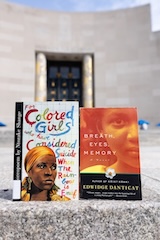
So it's a very—I think it's a very powerful work because it has so much. You know, the women of different colors, women in red, and it covers so many issues in the lives of Black women, and contemporary to her time. And then there's a version in which she updated it, you know, past the 1980s to include AIDS, to include the 90s, to include the Iraq War for the veteran who comes back. But there's just so many, it's so international. It's so global. It is a party we can all join, even though it's about these Black women, right?
Virginia Marshall Yeah, and it reminds me too of what you were saying earlier about growing up on oral stories, and this kind of idea that a story is something you interact with. The idea that you chose this as the book that influenced you makes a lot of sense, because it's a similar thing.
Edwidge Danticat Yes, and I think you're right. I didn't realize it until you've said that. I grew up hearing women tell stories, and here again are women telling stories, very in-depth stories. And I think that might've mirrored how I listened to stories growing up because there's a chorus, too. Right. There's like, there's the community. There's a call and response. There's an Amen corner. There's… this is not people telling their stories into a void. They have a whole community that’s like questioning—you went into that car with that boy? Or, you know… it’s a conversation.
[Music]
Virginia Marshall Thank you so much for being so generous with your time and your answers.
Edwidge Danticat Thank you so much. I'm just really happy to be included, to be part of this party. [Laughs]
Virginia Marshall We're very happy you are, too. [Laughs]
[Music]
Virginia Marshall Borrowed and Returned is a production of Brooklyn Public Library. It’s written and produced by me, Virginia Marshall, and co-hosted with Adwoa Adusei. Our Borrowed team is made up of Fritzi Bodenheimer, Robin Lester Kenton, and Damaris Olivo. Jennifer Proffitt and Ashley Gill run our social media. Laurie Elvove designed our logo. And Gregg Richards took the incredible photos of the authors you can see on our website and in your podcast app. Special thanks to 651 Arts, who let us record this episode in their studio.
Adwoa Adusei Brooklyn Public Library relies on the support of individuals for many of its most critical programs and services. To make a gift, please go to BKLYN Library [dot] org [slash] donate. You can read a transcript of this episode and our show notes at BKLYN Library [dot] org [slash] podcasts. We’ve put links to the books Edwidge Danticat mentioned in this episode, so you can check them all out from Brooklyn Public Library.
Virginia Marshall Next week, we’ll talk to another writer whose novel about migration and belonging influenced Edwidge Danticat… that writer is Julia Alvarez, author of How the Garcia Girls Lost Their Accents. So, keep listening!