Jose Antonio Vargas is a journalist, filmmaker, and author of the book Dear America: Notes of an Undocumented Citizen. He came to the US from the Philippines when he was twelve years old, and he didn’t discover he was undocumented until he was sixteen. We talk with him about his unique perspective on America and what it means to be a citizen.
- How many books have you read? Check out BPL’s full list of 250 books that influenced America, then check out our booklist with all the titles Jose mentioned in this episode.
- Read the 2011 New York Times essay in which Jose came out as undocumented and learn more about his organization, Define American.
- Watch the rest of Angela Davis’s talk at BPL’s 2026 Kahn Humanities series.
- Check out our booklist with all the titles Jose mentioned in this episode.
- Want more interviews with authors on BPL’s 250 for 250 list? We talked to Maia Kobabe (author of Gender Queer), Roxanne Dunbar-Ortiz (author of An Indigenous Peoples’ History of the United States), Art Spiegelman (author of Maus), N.K. Jemisin (author of The Fifth Season), and George M. Johnson (author of All Boys Aren’t Blue).
Check out our booklist with books recommended for this episode.
Episode Transcript
Adwoa Adusei A couple months ago, the activist, writer and scholar Angela Davis visited Brooklyn and stopped by the Central Library.
Angela Davis This is the first time I’ve been in the Brooklyn Public Library… since I was a high school student and I lived in Brooklyn, in Bed-Stuy! So it’s really wonderful to be here this evening.
[Music]
Virginia Marshall It was so exciting to have Angela Davis in the library, and the audience was packed! Davis was a professor of feminist theory and was active in the Black Panther movement and the Communist Party in the 1970s. Today, she’s most well known for her prison abolition work.
Adwoa Adusei This year, BPL chose her as the keynote speaker for the 2026 Kahn Humanities series, where she was in conversation with the writer Jelani Cobb. Together, they reflected on the 250th anniversary of the signing of the Declaration of Independence, and Davis ended up talking about the contradictions in that document.
Angela Davis I can’t imagine there ever being a propitious moment to celebrate the Declaration of Independence. That is to say, a moment that would allow us to look at it without recognizing its internal contradictions. I’m not of course saying that it’s not important. It is the founding document of this place that we inhabit, and I think we have a responsibility not only to understand it, but to understand also the ways in which it has been utilized both productively and sometimes quite unproductively.
Adwoa Adusei In her talk at the library, Davis said that this is a time to challenge notions we may have had about the ideals this country was founded on. So, Brooklyn Public Library did some looking back of its own… and came up with a book list.
Virginia Marshall That’s right. Earlier this year, BPL librarians, staff, and notable New Yorkers put together 250 of the most influential books in US history. The list challenges us to redefine what we think about when we think of America, and it has everything from Thomas Payne’s Common Sense to Maia Kobabe’s Gender Queer … Julia Child’s Mastering the Art of French Cooking to bell hooks’s Ain’t I A Woman.
Adwoa Adusei It’s an expansive list for sure! Angela Davis’s autobiography is on there, plus thirteen of the books we’ve covered elsewhere on the podcast, including interviews with four of the authors!
Virginia Marshall So, to honor that list… we at Borrowed decided to bring you six interviews with six of the authors featured on the list. And these are really exciting guests! We’re going to talk to Edwidge Danticat, Jacqueline Woodson, Linda Sarsour, Sandra Cisneros, Julia Alvarez, and Jose Antonio Vargas. We’ll release one interview a week for the next six weeks. Today, we’ll kick off the series with Jose Antonio Vargas, whose book Dear America made the list.
Adwoa Adusei This is Borrowed & Returned. I’m Adwoa Adusei.
Virginia Marshall And I’m Virginia Marshall. We’re back with our popular series, revisiting the books that changed us, and changed America, too.
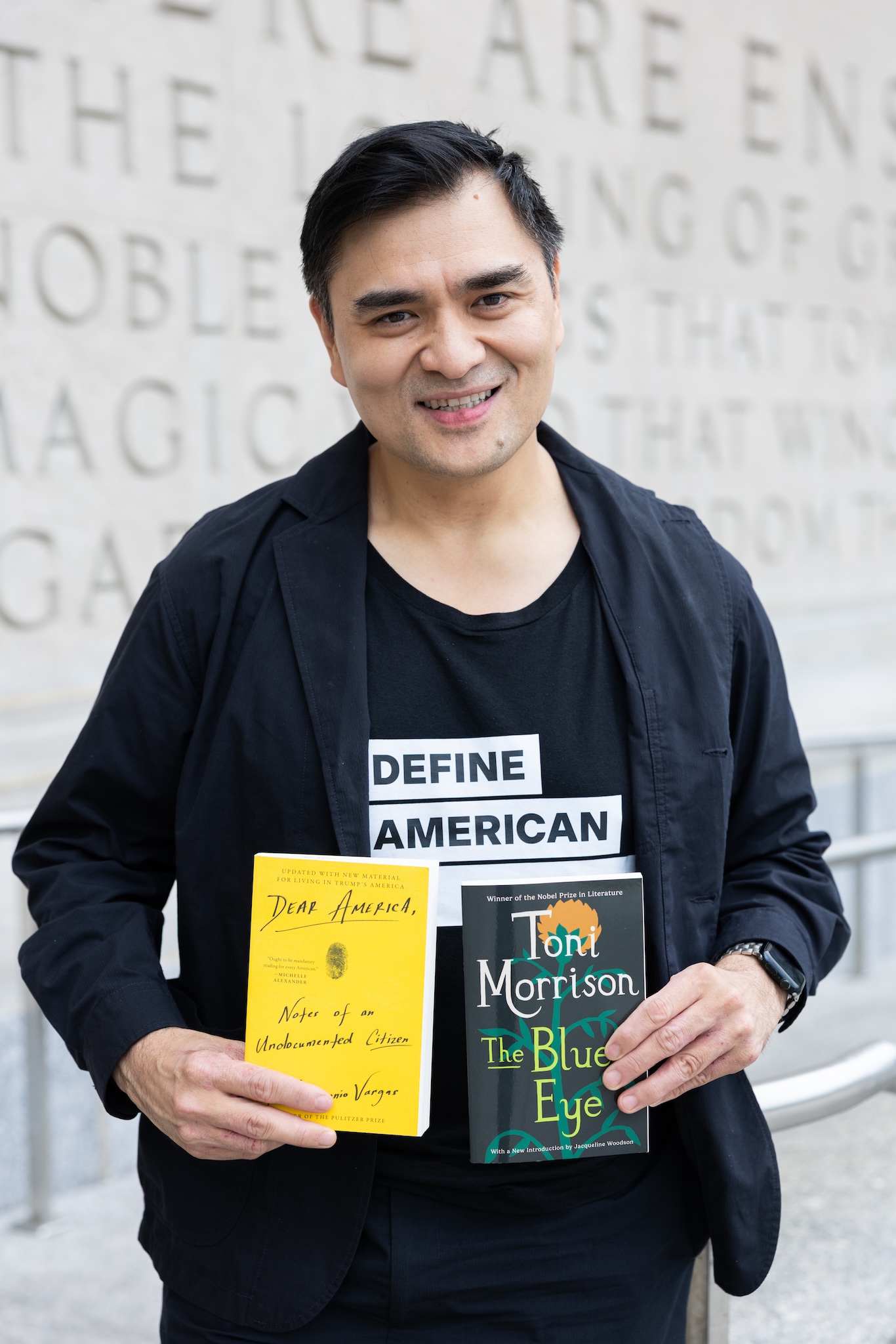
Caption: Jose Antonio Vargas with his picks from BPL’s list of 250 books that influenced America.
[Theme music]
Adwoa Adusei Jose Antonio Vargas is a journalist, filmmaker, and author of the book Dear America: Notes of an Undocumented Citizen. He emigrated to the US from the Philippines when he was 12 years old. He came on his own, with a man that his mother said was his uncle — and he lived with his grandparents in Mountain View, California. He didn’t discover he was undocumented until he was sixteen.
Virginia Marshall In the book, Vargas writes about that moment of discovery. He was trying to apply for a driver’s permit, and when he presented his green card as documentation, the DMV worker told him that it was fake. Vargas was confused. He went home and asked his grandfather, “Did you know this was fake?” And his grandfather looked him in the eye and said, “You are not supposed to be here.”
Adwoa Adusei That moment changed everything for Vargas, how he thought about himself, his family, and journey to America — but he still had to figure out a way to move forward. He had to get a driver’s license, go to college, make a living… all of that required that he lie, pass, and hide — those are the three words that make up the three-part structure of his memoir.
Virginia Marshall Jose became a successful journalist at The Washington Post, reporting on politics and current events. But over time, the truth of his immigration status began to weigh on him, and in 2011, he decided to “come out,” as he calls it. In an essay published in The New York Times, Vargas admitted that he was undocumented, and he cataloged exactly how he’d been able to “pass” as a citizen all of those years. When the essay came out, he got a lot of pushback.
Jose Antonio Vargas In 2011, that was considered a cardinal sin—that all of a sudden, I wasn't just writing the story, I made myself the story. And for some journalists, that made me suspect.
Adwoa Adusei But he also received a lot of support. People felt moved by his story, and the hoops he had to jump through in order to continue living in a country that was increasingly hostile to immigrants.
Virginia Marshall After his public declaration, he started getting queries from book agents, and they were like, you could write a book about this.
Jose Antonio Vargas I was just not ready—I was getting ready to get deported. I was not… [laughs] Because you know, 2011, that was the year President Obama deported 400,000 people.
Adwoa Adusei Vargas said he was ready for ICE agents to show up at his door and send him back to a country he hadn’t been to in eighteen years. It took another five years until he felt he was ready to tell his whole story. By that time, the country was in another moment of change.
Jose Antonio Vargas I started writing it when Trump was elected president the first time. The first line of the book is, “I don't know where I'll be when you read this book.” The last line of the book is my mom on a phone call telling me, “maybe it's time to come home.” And when I started circulating a draft of the book to close friends, they're like, are you leaving? Are you leaving? And I'm like, yeah, I have to promote the book, I’m contractually obligated to promote the book with Harper Collins, and then I'm gonna go leave. Because I was not, I didn’t … at that point, this was 2018—I just did not want to be a professional undocumented person.
Virginia Marshall Hmm. And why do you say that?
Jose Antonio Vargas Because being undocumented has become this kind of identity that's weaponized against us. At that point, I was 37 and I thought to myself, if I stay here, all I'm gonna be to people is some undocumented person, some problem that hasn't been solved.
Virginia Marshall You do write so well and passionately about how hard it is to be the face of something.
Jose Antonio Vargas Well, thank you. I really wanted to capture that. I wanted this book to be… you know, I was not a typical undocumented person. But what does that mean? And everything about this book, even the fact that the cover of the book is yellow, I wanted to just be like—I'm Asian, and yellow is connected to being Asian. Let me pick… because the moment people hear Jose Antonio Vargas, they think—right? And then I'm made to feel bad that I don't speak Spanish. I've literally had people tell me, like, why don't you speak Spanish? And I'm like, I speak Tagalog, and that's pretty good. I wish I could speak Spanish though.
Virginia Marshall You write in your book, too, there's a moment where you say, you know, it's wild, as you're saying now, that so many people in America have no idea what it takes to become documented, right? And I just had this thought when I was reading that, like, what do you think would change if more Americans—whatever that means to be American—did know about the process?
Jose Antonio Vargas I think we would actually be talking about solutions. People are just walking problems. We don't wanna solve it. And if you, and when I think about it—what is the incentive to solve it? This is a country addicted to cheap labor, right? This is a country of corporations making money off the backs of cheap labor. That's why, for me—by the way, I think books are always in conversation with each other. The fact that the Brooklyn Public Library chose this book, Dear America, as one of the 250 is to me, like… As someone who grew up in libraries, who I would not be the person that I am if I didn't have access to free libraries, and that's the Mountainview Public Library and the Los Altos Public Library, who I think I still owe some money to because of some late fees. Because, you know, it wasn't just books. It was like Anne of Green Gables. It was Nashville by Robert Altman. You know, like the library was like my Blockbuster. It was free. Blockbuster, you know what that is? It was like you know… [laughs]
Yeah, so this is a supreme honor. And so many of your books are books that my books are in conversation with. The New Jim Crow, Michelle Alexander. Amy Tan. I learned how to be a writer by reading The House on Mango Street. It was the first time that I heard a voice that—oh, I could sound, I think I sound like that, right? So I'm just really… Edwidge Danticat! I’m just really honored to be in community with all these other books. The fact that now there's a growing canon of books written by immigrants, formerly undocumented immigrants, like Karla Cornejo Villavicencio's book The Undocumented Americans is on your list. So, really, to me, actually the biggest honor that this book has gotten is to be included in this list. So, thank you.
Virginia Marshall Thank you so much for saying that, and you've named so many of these books—some of whom the authors are going to speak to—books that have had an influence on you and your writing. But I wonder, looking forward, because we've named your book as one that has influenced America… have you had interactions with readers or other writers where you see the impact that you've had?
Jose Antonio Vargas Yes. And it's deeply humbling. Meeting people… I was just in Ohio, in Yellow Springs, Ohio this weekend and I met this wonderful woman who had a dog-eared copy of the hardcover of the book, and I could tell she just wrestled with the thing. And she asked me a fascinating question. She said, “Can you talk to me about the rhythm of the book?” Which I was so happy she asked. From a literary perspective, that was my big goal. As you can tell, Toni Morrison—reading The Blue is Eye in eighth grade was my first literary experience. And, you know, I think Toni Morrison's last three or four novels, A Mercy, Home… in which, I mean, I call them “concentrated orange juice novels.” I mean they're like little, you know—she says a lot and so little. When I was writing Dear America, I was just emulating kind of the spareness of the language and the build, right. Like the original draft of this book was a lot longer and I really wanted to—I wanted the reader to understand that to be undocumented means to lie, to pass, and to hide. And you live your life on the run. So I wanted the book to read that fast. Like there's one chapter that's like two pages, right? Like I just really wanted the reader to get that sense of movement, of like, I'm running away, I'm running away, I'm running away.
And thankfully, after this book, I got a therapist. [Laughs] That's really good. But really, you know young kids, young people who experience some sort of a trauma in their lives… memory, what you choose to remember and what you don't want to remember, a lot of that is because, you know—I got here, then found out that I wasn't, that my mom wasn't going to follow me and that these adults who were in charge of me didn't know how to be in charge of me. <y trauma response was to just keep moving forward like a shark and just... So, I wanted the book to kind of capture that.
Virginia Marshall That's amazing. And I want to also say, like, even though the title of your book, the subtitle is Notes of an Undocumented Citizen, so we know you're undocumented going into the book, right? You still managed to make that moment of the revelation where you yourself, as a younger person, figure out that you're undocumented—you still manage to make that a revelation. So, just to say that I felt drawn along with your story as well, knowing all that I know.
Jose Antonio Vargas And by the way, that's the other thing. It's like the title, Dear America, was not my title at all. And again, since we're talking here about books, like Julia, the editor of this book, Julia basically said to me, Jose, immigration books don't sell. So—and this was before The Undocumented Americans, before Solito, right? Like, immigration books don't sell. And so we need a title that could be palatable. But thankfully, she allowed me to keep the Notes of an Undocumented Citizen, which of course is a nod to Notes of a Native Son.
Virginia Marshall And the fact that it's like, it's Dear America, right? You're like addressing someone. It's like a letter to all of us. So I felt that, too. I wonder if you could talk a little bit more about this undocumented citizen, like putting those two words together. Why did you do that?
Jose Antonio Vargas Because to me that's actually the conversation. Like, what does it mean to be a citizen? Ever since I was a kid, I have heard that undocumented people, illegal aliens, that whatever term is being used—that people like me should “earn our citizenship.” And because I'm a student of Toni Morrison, one of the things she taught me was, the glove must always be pulled inside out. So if you're asking me what I've done to earn the citizenship, what I’ve done? I'll never forget I did this, I think it was somewhere in Nebraska where in front of an audience, mostly white, I asked people—how many of you are U.S. citizens? Everybody raises their hand. What have you done to earn it?
Virginia Marshall And did anyone have a response?
Jose Antonio Vargas Deep uncomfortability. Because I'm not sure U.S. citizens—I'm not sure Stephen Miller wants undocumented people to actually ask him that question. We don't want to be in competition with each other, although that's what they want. You want to actually, as undocumented people who have lived there for decades, paid into the same tax system that you have, and now those taxes are being used to arrest and detain and deport them—and you want to actually ask them to justify their existence to you? What have you done to justify your existence? Oh, you were born here? So what is this, immaculate conception? The accident of birth? How do you thank your parents for fornicating and allowing you to be born? Unless you're willing to have humility, I'm not sure anybody's in any position to ask anybody what they've done to earn… And then the complication of that, given where we are in this country, I actually think practicing citizenship is where we all must meet.
Virginia Marshall Yeah, right, citizenship is not just a right, it's actually something that you can practice.
Jose Antonio Vargas You have to practice. It means talking to people who don't agree with you. It means making sure that my equality is tied to other people's equality.
Virginia Marshall When Jose came out as undocumented in 2011, he left his job at The Washington Post and founded an organization to promote more nuanced and rigorous storytelling about immigration. It’s called Define American. I asked him to talk more about why he founded the organization.
Jose Antonio Vargas The day the New York Times published my essay, Define American was born. And the whole goal was, how do we actually humanize this conversation that has been so inhumane? And because I'm a journalist, really our first target audiences was journalists. And one of the first speeches I ever gave was at a journalism conference challenging the Associated Press and The New York Times to stop calling people illegal. You can use undocumented, unauthorized, people here illegally, but people can't be illegal because human beings can't be illegal. And then, how do you legalize people you call illegal? You don't. You spend billions of dollars keeping them illegal. You know, my mom, you know, this is the biggest change of my life. My mom and I just reunited.
Virginia Marshall Wow. Where?
Jose Antonio Vargas Yes. So after waiting for 27 years, for her green card to get approved. It got approved. She got approved right before Trump took office. So she arrived last… a year and a half ago almost. Like a character from a Toni Morrison novel, she just arrived. [Laughs] It's bigger than language. I don't have language for it yet. So I was so anxious about a 31-year reunion with this woman, and how we were going to react to each other. Then I saw her with her mom, my grandmother who raised me, and they had not lived together since 1974. So then I realized, watching the two of these women interact with each other, not knowing each other really… I'm like an appetizer to their entrée, like they're the entrée. So I moved both of them with me, in my house in Berkeley, California.
Virginia Marshall Wow. How was that going?
Jose Antonio Vargas The Joy Luck Club meets The Golden Girls. I'm Blanche. Thankfully, there's an ADU in the back. So I'm like living now in like this ADU in the back and I gave them… because I think all their feelings and all their emotions need to be contained in the house by themselves. So they're in the house. And, one morning, I mean, I get up early for work and I'm working and I’m watching the two of them in the kitchen and I can see them grab, try to grasp at each other because, you know, they're getting to know each other, right? And then I said to myself, is migration worth it? Is this worth it? Should my grandmother have left the Philippines in 1984? The whole American dream, sacrifices of the family, better life… all of those, right? Is that worth it given that there's now three generations of people in this house who don't know each other? And then by nighttime we were making dinner, then the question turned to, is migration inevitable?
Virginia Marshall Did you ask your mom or your grandmother whether it was worth it?
Jose Antonio Vargas We're starting to have that conversation. I'm starting to sprinkle it. So, our reunion, the three of us living together for the first time since 1984, it's gonna be the jumping up point I think for the third book. It's like the global migration part of this. And it's interesting too, both women, both women—it wasn't their choice to move. The men made the choices for them.
Virginia Marshall And you have not seen your mom since you left the Philippines?
Jose Antonio Vargas Since 1993. So, but again, right now, when my friends asked me about it—it's been a year and a half now. It's bigger than language. And so I'm still trying to find the language to explain what it's like. So now, I'm learning how to be her son and she's learning how to be my mom, while her mother is learning—my grandmother talks to my mom like she's a teenager, because I'm realizing, because the last time they spent this kind of time … she was a teenager. So there's all these like complicated…
Virginia Marshall Yeah. It’s just hitting me right now that this is the real impact of us not having figured out how to make people documented, or let people in. Like, this is the real tragedy, that losing of relationships.
Jose Antonio Vargas And I’m not… you know, America relies, has always relied, on people making these choices. And now that we are where we are, thinking about all those people that are not going to make that choice, who are not gonna come, who don't want to come anymore. So, that's where we are, and I think in a way, the narrative around, here in the U.S. we call them immigrants, the rest of the world calls them migrants. There's now, I mean, Edwidge Danticat, I mean she's on the list, Creating Dangerously is like a bible for me, right? So, I think the whole immigrant canon is being formed, is currently being formed. And, how do we do it in a way that is creatively borderless?
Virginia Marshall I have, I think, one final question, and then I want to see if there’s anything else you want to talk about. I was really struck, I think this is in the afterward, so you wrote it in 2025. You write about an abusive relationship with America, that it's like co-dependence, you can't get out of it, and I just was so… yeah, I guess I wonder, like, does it still feel that way? Maybe it does, by your expression. Where are you now in your relationship with America?
Jose Antonio Vargas You know, I'm a 45-year-old man who's never been in a long-term relationship with another human being. Because I am in a “complicated relationship” with this country. And I am who I am because of what I have become in this country. I choose every day to be grateful for what it's given me, and not focus too much on what it's taken from me. The fact that I have been able to create myself here. You know, look, like, I ended up getting this visa—I write about it in the afterword (thank you, by the way, Carrie Thornton, my editor who edited it, at Dey Street)—I ended getting, I joke that it's the Melania Trump visa, it's the extraordinary ability visa—O1, they call it. It's valid for three years, and it's gonna expire November 27, 2027, next November. And the visa is eligible to get renewed, yearly renewal, and I can't renew until next summer. And my lawyers are just preparing me for the fact that it might not get renewed. Which would mean I'd have to come back to the Philippines and then try to figure out a way to come back. So I am starting to wrestle with that idea, meaning I may have to leave next November, about eighteen months. There's a part of me that's really ready to see the world, but you know the whole world is in Queens. [Laughs] I could just, I could take the subway and be in the middle of Queens and be that, be in the whole world. However, going home to the Philippines and smelling the Philippines, I'd love to see India. I'd love to see South Africa. I'd like to see Istanbul, where Baldwin spent a lot of his time. So, I'm looking forward to that, knowing that wherever I am, I carry America with me.
Virginia Marshall Right, you write in your book that you could not be who you are today without this country.
Jose Antonio Vargas I would not be who I am. And again, that's the… that's the gift and the challenge, right? And again, that Baldwin quote, "I love America more than any other country in the world and exactly for that reason I insist on the right to criticize her perpetually." It comes from a place, a deep place of love. And understanding. You know, I have an understanding, I think, of my place—precarious as it is—in this country. And writing has afforded me that. Like the fact that I get to write my way to America is an incredible, incredible gift.
[Music]
Virginia Marshall Borrowed & Returned is a production of Brooklyn Public Library. It’s written and produced by me, Virginia Marshall, and co-hosted with Adwoa Adusei. Our Borrowed team is made up of Fritzi Bodenheimer, Robin Lester Kenton, and Damaris Olivo. Jennifer Proffitt and Ashley Gill run our social media. Laurie Elvove designed our logo. And Gregg Richards took the incredible photos of the authors you can see on our website and in your podcast app.
Adwoa Adusei Brooklyn Public Library relies on the support of individuals for many of its most critical programs and services. To make a gift, please go to BKLYN Library [dot] org [slash] donate. You can read a transcript of this episode and our show notes at BKLYN Library [dot] org [slash] podcasts. We’ll be back next week with an interview with the great Jacqueline Woodson.