When award-winning author Jacqueline Woodson sat down to write her family’s story of the Great Migration, she wanted to make it accessible to all kinds of readers. So she wrote a children’s book called This Is the Rope. In this episode, Woodson talks about the importance of preserving the stories of our ancestors, and of course… her love of Brooklyn.
Want to learn more about the topics brought up in this episode? Check out the following links:
- How many books have you read? Check out BPL’s full list of 250 books that influenced America. Then check out our booklist with all the titles Jacqueline mentioned in this episode.
- Learn more about Baldwin for the Arts, and listen to the Baldwin-Emerson Elders Project.
- Watch the rest of Jacqueline Woodson’s talk with Edwidge Danticat at BPL back in 2016.
- Want more conversations with authors on BPL’s 250 for 250 list? Check out the following interviews: Jose Antonio Vargas, Dear America; Maia Kobabe, Gender Queer; Art Spiegelman, Maus; N.K. Jemisin, The Fifth Season; George M. Johnson, All Boys Aren’t Blue.
Check out our booklist with books recommended for this episode.
Episode Transcript
Jacqueline Woodson I remember the first time I read Mildred Taylor's Roll of Thunder, Hear My Cry, and realizing that there was such a gap in my literature where Black girls were supposed to be. And I wanted to fill that gap.
Virginia Marshall This is the writer Jacqueline Woodson.
Jacqueline Woodson Like even as a little kid, I'm like, I wanna write stories where people look like me. And so yeah, I don't know if it was intentional or if that was just like writing what I knew and those were the people I loved and those were the things I thought about and dreamed of. And I do think it is this maybe unconscious, maybe subconscious, maybe conscious, I don’t know... way of writing myself into history.
Adwoa Adusei Jacqueline Woodson did go on to write herself into history. She’s the author of over thirty books, including over a dozen picture books, and books for adults, teens, and middle grade readers. She’s won some big awards, including the National Book Award for her memoir-in-verse, Brown Girl Dreaming, and a Hans Christian Andersen Medal, one of the highest honors in the world for children’s literature. She was also the National Ambassador for Young People’s Literature in 2018.
Virginia Marshall So, it comes as no surprise that Woodson is on our list of the 250 books that influenced America, along with Roll of Thunder, Hear my Cry, which Jacqueline just mentioned as a book that influenced her growing up. We got to talk with Jacqueline about her work for young readers and adults – and how she honors the people who came before her. It’s a great conversation, so keep listening!
Adwoa Adusei And I’m Adwoa Adusei. I’m Virginia Marshall.
Virginia Marshall And I’m Virginia Marshall. This is Borrowed & Returned: a podcast series about the books that changed us, and changed America, too.
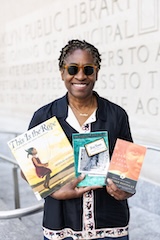
Caption: Jacqueline Woodson with her book picks from BPL’s list of 250 books that influenced America.
[Theme music]
Adwoa Adusei Jaqueline Woodson has so many fantastic books, but the one that BPL librarians selected for the 250 list was a picture book called This Is the Rope: A Story from the Great Migration. It’s illustrated by James Ransom, and it's a story of a piece of rope that travels down generations from South Carolina to Brooklyn as one family passes down this object. It's used to tie suitcases to cars, to hang laundry, and to jump rope… so we started the interview by asking Jacquelin where the idea for the story came from.
Jacqueline Woodson I love that question, and I haven't thought about it in a while because This Is the Rope was published some time ago. But I remember when I was writing it, thinking about that, what if there was an object? Especially in Black communities and folks who have been part of the Great Migration, like my own family, you lose a lot of stuff on the journey, just because that's what having to migrate means, leaving stuff behind. And I thought, what if there was, what if I created a story where there was an actual object? And I made that object the rope because I figured that was the most, in families you can find a lot of uses for a piece of rope. And then I realized as I was writing that the rope was more symbolic of the hope that we pass down through the generations. Even though we don't always have physical objects to pass down, but we do have that hope and that litany for survival.
Adwoa Adusei And it definitely felt like a literal through line, you know, something tying everything together. So, yeah, very strong, very compelling. What did you want to say to young people about the Great Migration?
Jacqueline Woodson A lot of people didn't know for a long time about the Great Migration. I mean, I think the story started becoming more amplified probably in the late 20th century. I know I would go to schools and talk to kids about it and they had no idea. And so I wanted to talk about it. I wanted to talk about a movement of people that changed the history of this country. And that's what the Great Migration did. So, around the time that This is the Rope came out, The Warmth of Other Suns came out, Isabel Wilkerson, which is, to me, the adult version of This is The Rope, and really did talk a lot about the Great Migration through the voices of three or four narratives, I think, it was four narratives, I can't remember now. And I love that book so much. And so I really wanted to put that on the page, that this was a moment in history that you might not learn about in schools, that your families might not talk about. I mean, my family didn't talk about the movement, or the reasons for the movement for a long time, if ever. And we heard stories that like my uncle came here because he was probably escaping a lynch mob. You know, he ended up changing his name, and you got whispers of stories. But I think there was a lot of trauma sometimes with the leaving and people—just like with any kind of migration or immigration—a lot of times people don't want to bring that bad luck with them to the new world, and so they don't talk about it.
Virginia Marshall So I was actually listening to a conversation you had with Edwidge Danticat at BPL in 2016, so going back a while. And you said something really interesting about Brown Girl Dreaming. Edwidge asked you why you wrote it in verse. And you've said that since the book was made of memory, the white space was important to the story to kind of create this physical space on the page for memories to sink in. And so you've written in so many different forms, picture books, of course, books for adults, poetry. And I was wondering, how do you make that decision about what form is best for a particular story?
Jacqueline Woodson I remember years and years ago hearing Cornelius Eady, who is such a great poet and was the inaugural poet for Mamdani—talk about how sometimes the story knows more than you do about what it's trying to say. And I feel like I start writing and I have a plan and the story has another plan. When I was writing Brown Girl Dreaming, I was just writing down memories and I didn't know what it was going to become. I thought I was wasting my time, but I had to write it. And then I thought I could shape these memories into a straight narrative. And I couldn't, because that's not what the story wanted to say, because it was talking about memory, and it was talking about the spaces, the white space where the mind needs to rest, where the unknown lives, where the wonder lives. And so I didn't know until I finally knew what that book was trying to say.
And with something like This Is the Rope, I hear parts of the story, but I find that with picture books, they're much more visual in my head. And I know this is a picture book because of the way I'm seeing it. I'm the images, I'm seeing the movement of the characters. And so I don't make plans. I mean, I don't outline. I really don't know where a story's going till I get there. Or maybe around the middle of the book is when I start really getting to the scaffolding to get to the story to the end. But the form kind of chooses itself, and sometimes it takes many forms. I think about Another Brooklyn, which is an adult novel I wrote, and it's non-fiction in that it’s the story of Bushwick in the 1970s, New York City during that period. And then it's fiction in that it is the narrative of four girls. And then it's poetry in the intentionality of language, and again with the white space and the way I'm very intentional about what words I use and the ways the words play together, and the way it sounds when I read it out loud. So, I can say that's a novel. But I would have to say it's a novel and... like, and the plan had been to write a novel, but it became something different.
Virginia Marshall That’s really cool, thank you.
Adwoa Adusei So many of your stories start with recitation of ancestors. This Is the Rope is all about where we come from, but also Brown Girl Dreaming starts with people who came before. So, why is it important for you to start your stories that way?
Jacqueline Woodson I think it's so important for all of us to start our stories that way… because of them, we are. And I wouldn't be here if it wasn't for my mom, my dad, my grandmother, my great-grandmother, my great-grandfather. And when I wrote Show Way, there's a part in the book—and that's a story tracing the maternal line of my family back seven generations—and we got to my great great-grandmother and no one knew her name. And you know in the book I say, “And history went and lost her name, and years later Soonie came.” And Soonie was my great grandmother. And when I try to go through everything, what was written down, what was held by the government, what my family remembered… no one had her name. And I think that's really important, right, there's this gap in where this woman once was. And, what did she do, what did she love, how did she laugh, what did she dream of? All of that leaves with her. And I think when I was writing that book, I thought, let me just make up a name and put it here. And I didn't want to lie. I didn't wanna tell that untruth and make it seamless, because our journey to this point was not a seamless journey. And so remembering the people who came before us is so important to me for that reason, and also it gives me clarity. I know that, again, I am here because of them, and I know their names, and I think it is important for us to speak the names of the dead, the newly dead, the new ancestors, the people who came before us. So that we understand very, very deeply why we are here, and how we made it here.
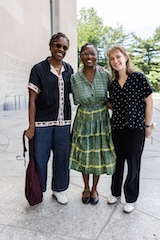
Caption: Jacqueline Woodson with co-hosts Adwoa Adusei and Virginia Marshall at Central Library.
Adwoa Adusei Thank you for that answer.
Virginia Marshall So I want to talk about Brooklyn. Place in general is so important to your writing. Your characters end up in Brooklyn in This Is the Rope, and in Brown Girl Dreaming, of course, but also Brooklyn is an important character, and two of my favorite adult novels of yours, Another Brooklyn, of course, and Red at the Bone. So, what does Brooklyn mean to you?
Jacqueline Woodson I love Brooklyn so much, you know, it's so funny because my beloved works in the Bronx, and it's a long commute and we've talked about moving somewhere else. And the furthest I will move is Greenpoint, because that's the most northern point in Brooklyn where you're still in Brooklyn. [Laughs]
But this is home to me and even though I still call down south, like my parents did, home. You know, when I go back down south, I'm going home. But Brooklyn is in my blood and I always talk about how it's both ever-changing and evergreen, right? So, like, when I wrote Another Brooklyn, I was writing about a Bushwick that doesn't exist anymore. And the same thing with the neighborhood I live in now, Park Slope, I remember when one of the nicknames for it was Dyke Slope. You know, and there's so many parts of it that keeps changing and changing but the essence of it, like childhood—I mean when people ask how do I write books to young people… like, the essence of childhood doesn't change, right? And the essence of a place hopefully doesn't change so much. I mean, I have seen a lot of changes in Brooklyn from old Brooklyn that was… I'm thinking of my neighborhood and Park Slope that was predominantly Polish and Italian and Irish, watching not only those people die off, but the way they spoke die off with it. So it's hard to find that old Brooklyn way of talking where it's like, “where youse people going” that we used to hear all the time. But the essence of the place is so deeply in my blood that I can't imagine not being a part of it somehow.
Virginia Marshall Yeah, and your necklace says Brooklyn, I just noticed.
Jacqueline Woodson My necklace says Brooklyn, I know—someone called me Brooklyn. They're like, isn't that your name plate? I'm like, no… [Laughs]
Virginia Marshall That’s great. One more Brooklyn question, which is do you have a favorite library branch? Or favorite place to write?
Jacqueline Woodson Oh, so Brooklyn Public Library Grand Army Plaza is my teenage library. I would come here and with my besties from high school, and we'd write our papers here. You know, that we'd go down to the café and get lunch and then come back and work here all day. And I think it was open on Sundays at that time, too. I remember us spending our whole weekend—and it was a trek coming from Bushwick to this library. It was two trains. But we loved it. It was like, you know, we were such geeks anyway. [Laughs] So it was like yay, we're going to go to the library, we're gonna work together on our papers. And then Washington Irving was the branch of my childhood and I lived there. You know, I would have to go there, my siblings and I would walk from the school to the library and we'd be there until like 5:45 until my mother came and picked us up from work. So, you know, it was kind of childcare slash after school slash, you know, study hall.
So those are two of my favorites. But you know, I've been to libraries in East New York, I've been to libraries in Brownsville, and I'm always so happy when I walk through the doors. I'm happy to see librarians there, I'm happy to see the community using the library. Like even walking into this library today and seeing all the young people sitting at the tables outside and that the tables have umbrellas, which is to me about care, right? Like, someone cares enough to make sure there's shelter both inside and outside of the space. And that's huge.
Adwoa Adusei In 2018, Jaqueline founded the organization Baldwin for the Arts, an artist residency for members of the “global majority.” She also created an oral history archive of black and brown elders interviewed by black and Brown writers. It struck us that the organization—and the oral history archive—had a lot in common with the work Jacqueline does in her own writing. So we asked her to tell us more about that project.
Jacqueline Woodson I'm always thinking about shelter. You know, it's important to me that artists are sheltered and supported any way that we can support them. It's important that public institutions are sheltered and supported. And it's important to me that people of the global majority have safe spaces in the world. And so when I was building Baldwin for the Arts, I was thinking of the many times where I've had to walk into rooms where I was the only person like myself. Going back to, of course, The Day You Begin, the picture book. And both the loneliness of that and also... I wouldn't say anger, but like the dissatisfaction, and wondering, where my people at? And what has happened in this space that has made it uninviting, unsafe, unwelcoming. And so when I was building Baldwin for the Arts, I wanted to create a safe space. I wanted to create a place where people could create art and not have that art pushed back against, or not have the art seen as lesser than, and just be supported. When I was a young writer, one of the places that sheltered me, it was called the McDowell Colony at the time, it's now called McDowell. But it was one of the first places that accepted me as a writer. And I have lots and lots and lots of love for McDowell. I'm actually going back in the autumn. But many was the time that there were very few Black and brown writers there, or Black and brown artists. So you're, you know, a few among many. And it's always nice to be in a space where that's not the case.
And so, when I created the Baldwin Elders Project with the help of the Emerson Collective and Laurene Powell Jobs, who helped support it financially, it was to get the stories of everyday people out in the world. So that young people can hear them. They can hear these stories of what it was like to be part of the Black towns in New Mexico. I had Ellery Washington go collect those stories because he's from New Mexico And when I met him, I didn't know there were Black folks in New Mexican. I was like, wait… He's like, there were actual Black towns that ended up getting destroyed, going under. You know, I had Natalie Diaz go back to the reservations and get the stories of Indigenous folks. And one of the people she gathered the stories of passed away, and he was the last person to speak that language. So, she was able to get a lot of that language and interpret it. Eve Ewing interviewed the elders in the projects in Chicago who have amazing stories. So I really wanted people to have access to the folks all over. Caleb Gale got stories of the descendants of the Tulsa race riots. He's from Tulsa, Oklahoma. And I wanted them to be publicly accessible, free of charge, so that people could just go listen and know that not only were we here, but someone lived to tell the story, and no one can say this never happened.
And I think that is one of the things that I fear that our history will be erased. I mean, even going back to Bushwick. Bushwick was originally called Boswijk, it was founded by the Dutch, right? Or not founded—Columbused is what we say—by Dutch folks. And one of the people who helped settle that land was Franciscus the Negro, who was an escaped enslaved person. So one of the “founders” of Bushwick was a Black person. And we don't know this because you have to dive deep to get this information. Then you hear about people “discovering Bushwick” in the 90s, right? And it's like, no, we were here. And so just being able to write that down, to have people speak it, to have the living voices of that history tell that history was really important to me.
Virginia Marshall Really cool. We’re wrapping up here. I wanted to speak to you about the 250 list. We're speaking to you because, you know, BPL librarians selected your book as one of the 250 that influenced America. And so I wondered, how do you think your book influenced its readers or other books, maybe?
Jacqueline Woodson You know, it's so funny, because I am a little surprised that This Is the Rope is the book that was chosen. And now I do understand it. I mean, I wonder, I thought Brown Girl Dreaming felt like it had much more wingspan. And I do understand that at the core, this is an early introduction to a big part of our history in this country. And so I'm glad about that. I'm that they chose a picture book that speaks to both the young folks and old folks. And I think that's the beauty of picture books. Like, when you look at an adult book, they're not always accessible to the very young. But a picture is accessible to very young and the very old and the people in the middle. So it begins to have a longer life. I love the fact that I think of grandparents reading it to their young people and telling their own stories. And I think story is so much a part of keeping history alive. And so, the fact that you can pick up This Is the Rope, read it to yourself, read it to someone, and then remember your own stories about your own migration or immigration, however you got to this country—makes me feel like I've done my work. [Laughs]
Virginia Marshall Cool. That makes sense.And then, are there other books on the list that influenced you or your writing?
Jacqueline Woodson Oh my goodness, there are so many books on that list. It's a really great list. I was so surprised to be… like, oh yeah, I'd love this book. Oh yeah, of course, this should be on the list. But I definitely am so excited that Edwige's book, Breath, Eyes, Memory is on the list because I remember reading it in the 90s. And at that time I was a young writer myself and Edwidge came up a little bit after me—and being so excited about this writer and the stories that she was telling about Haiti, and about what it means to be Haitian-American. And it was at this time where this country was being really toxic to Haitian immigrants. And so here was this voice breaking through the noise and the racism and all of that stuff and bringing this clarity. And she's just such a beautiful and brilliant writer. And that book is, that book and Krik? Krak! were the two that I'm just so glad they're on the list. And then of course, also Alison Bechdel's Fun Home, which also got wings as this amazing musical. I don't know if you got to see it yet. Oh my goodness, it was so great. But Fun Home is just such a—you know, the thing I remember about it was Alison telling this story of this queer, kind of rural experience, right? They lived in Pennsylvania, I think it was. But I'm such a city girl, and so to be able to have this experience so outside of anything I knew, and to have it in a graphic book was so different than what I had been experiencing.
And… oh yeah, Brown Girl, Brownstones, Paule Marshall, which had a huge impact on me as a young writer. I wanted to live in a brownstone. It's a really quiet book. It's really, my memory of it is, it's really contemplative. I feel like Brown Girl, Brownstones definitely influenced Another Brooklyn. I mean, Another Brooklyn, the title comes from, of course, Another Country by Baldwin and Colm Toíbín's Brooklyn, but also A Tree Grows in Brooklyn. When I was thinking about the title, I was thinking about all these books that centered Brooklyn. And of course A Tree Grow in Brooklyn is on the list, which I probably read about 15, 20 times, like from childhood into adulthood. And it still holds up. And that's another thing about the list, the books hold up, you know, and I'm sure that's why so many of them got chosen. Of course, there are newer narratives on the list, but the ones that go way back—Fahrenheit 451, my son reads that too often for my liking. [Laughs] I'm like, you know, let's find some joy. But the way that they hold up outside of classroom assignments, outside of, you know, childhood reading. So there are definitely books that I've gone back to and I'm like, eh, no never mind. It was good when I was eleven, it’s not working now… But so many of the books on the list hold up. And really when you pull them all together it's like, yeah, this makes sense for the 250th “anniversary.”
[Music]
Virginia Marshall Borrowed & Returned is a production of Brooklyn Public Library. It’s written and produced by me, Virginia Marshall, and co-hosted with Adwoa Adusei. Our Borrowed team is made up of Fritzi Bodenheimer, Robin Lester Kenton, and Damaris Olivo. Jennifer Proffitt and Ashley Gill run our social media. Laurie Elvove designed our logo. And Gregg Richards took the incredible photos of the authors you can see on our website and in your podcast app.
Adwoa Adusei Brooklyn Public Library relies on the support of individuals for many of its most critical programs and services. To make a gift, please go to BKLYN Library [dot] org [slash] donate. You can read a transcript of this episode and our show notes at BKLYN Library [dot] org [slash] podcasts. We’ve put links to the books Jacqueline Woodson mentioned in this episode, and also a link to the Baldwin-Emerson Elders Project, the oral history archive of Black and brown elders that she helped create.
Virginia Marshall Next week, we’ll bring you an interview with another writer Jacqueline mentioned: Edwidge Danticat. So, stay tuned for that!