Did you know that in August 1776, the first and largest battle of the American Revolution took place in what is now known as Brooklyn, New York?
This map highlights some of the pivotal sites connected to the War, its historical context and diverse perspectives, as well as monuments and memorials that Brooklynites have created over the past 250 years to commemorate the borough’s Revolutionary War past. Download a PDF of the map.
The Battle of Brooklyn: Fought and Remembered at the Center for Brooklyn History explores this remarkable story through artifacts, archival documents and rare maps. The exhibition is free and on view until December 31, 2026 at 128 Pierrepont Street.
Join the Center for Brooklyn History on Saturday, August 22nd, 2026 for CBH’s Battle of Brooklyn Community Day celebrating Brooklyn’s unique role in the founding of America. This family-friendly event for all ages features kids’ storytime, craftmaking and hands-on activities; curator-led exhibition tours; special access to CBH's collection of Revolutionary-era archival material, artwork, and historic artifacts; and 18th-century-style music and dancing with Brooklyn Contra.
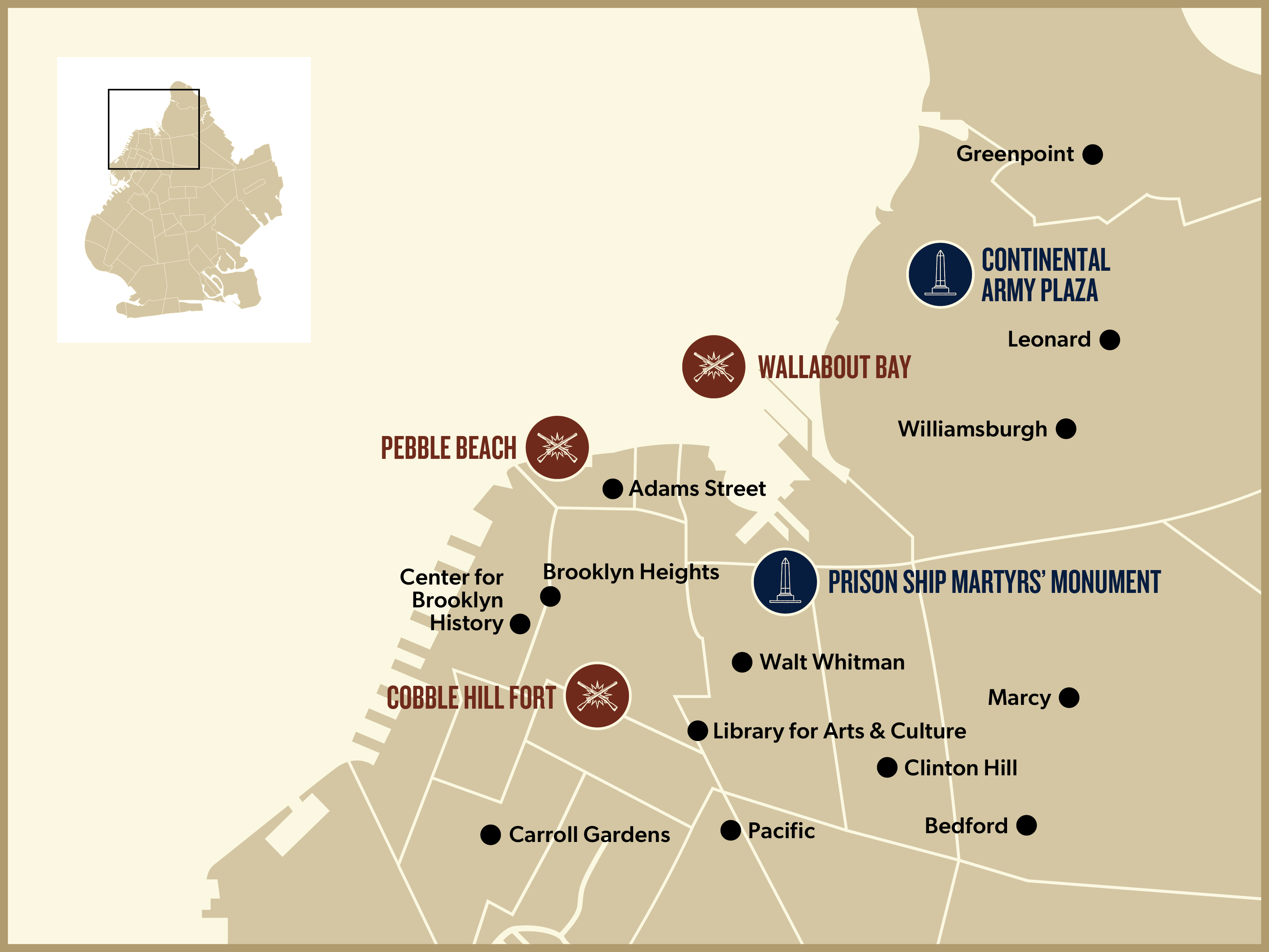
Continental Army Plaza
This 1906 statue, located by the Williamsburg Bridge on the Brooklyn side, depicts Washington during his encampment at Valley Forge. Williamsburg also played an important role in the Revolutionary War; its waterfront was a staging ground for British troops following the Battle of Brooklyn. Learn more about the monument and view location.
Wallabout Bay
While the Continental Army managed to escape Brooklyn without surrendering, the battle was lost. The British would occupy New York City for the remainder of the war. Captured Continental soldiers and New Yorkers who had refused to sign a loyalty oath to King George were held prisoner on boats anchored in Wallabout Bay, outside of today’s Brooklyn Navy Yard. Learn more about the Brooklyn Navy Yard and view location.
Pebble Beach
After a week of fighting, British General William Howe prepared to besiege the remaining American troops in Brooklyn Heights. Hidden by the cover of night and a dense fog, George Washington and the remainder of his men were able to escape the British by boat, sailing across the East River from Brooklyn to safety in Manhattan. View location.
Prison Ship Martyrs' Monument
In 1808, Brooklynites first tried to construct a monument to those who perished aboard British prison ships in the East River. The project was largely unsuccessful. It was not until 100 years later that the Prison Ships Martyrs' Monument, a nearly 200-foot column, was opened to the public in Fort Greene Park in 1908. Learn more about Fort Greene Park and view location.
Cobble Hill Fort
As the overpowered American troops faced the British army’s wrath, Commander-in-Chief George Washington watched from his spyglass at the American fort. (Can you picture the Trader Joe's on Atlantic Avenue? That’s where the fort was located!) Helpless to stop the massacre, Washington commended the bravery of his soldiers and prepared for the next British attack. View location.
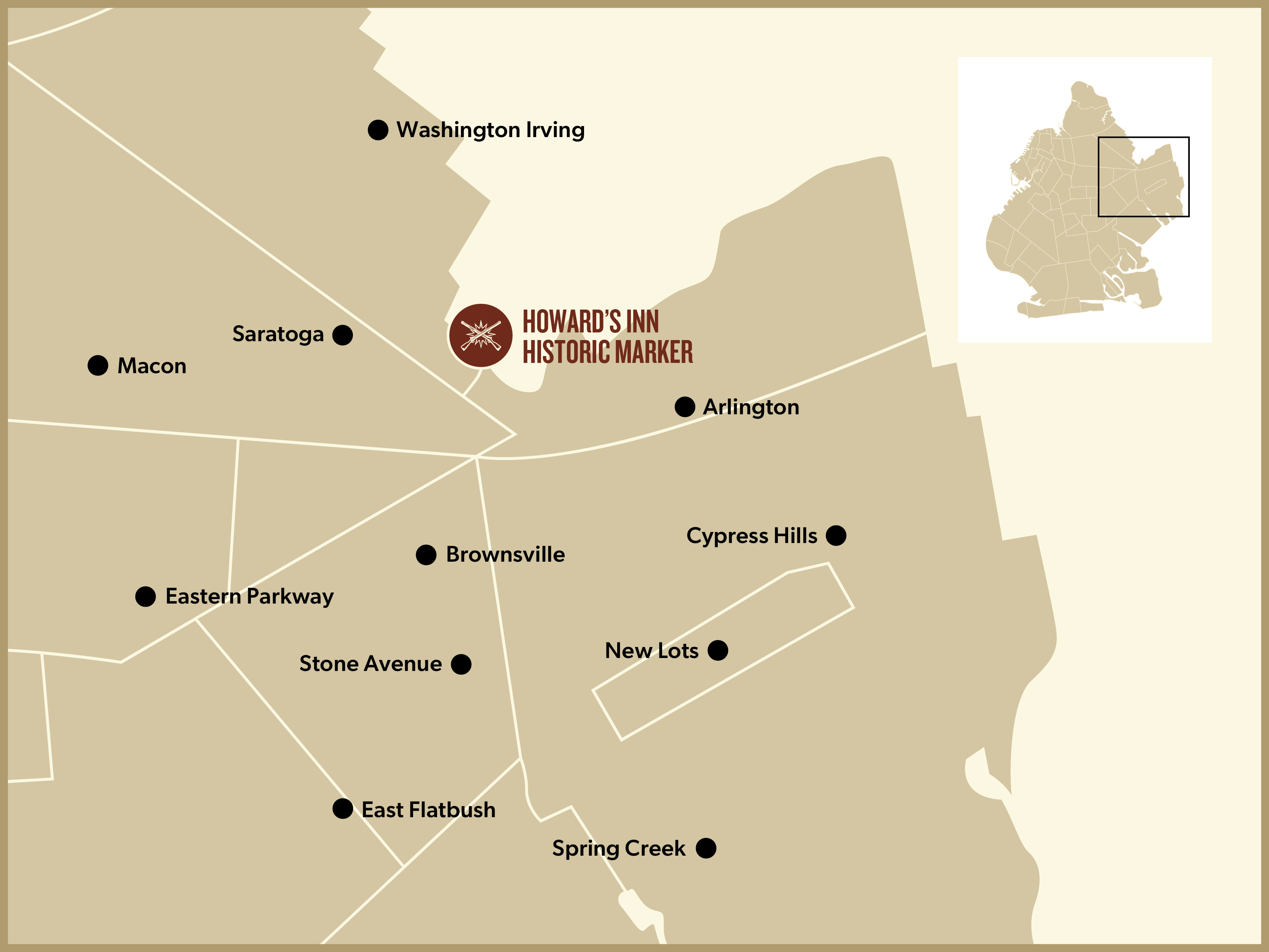
Howard's Inn
After landing in Brooklyn and skirmishing with American troops, a detachment of British soldiers was sent to the village of New Lots during the evening of August 26, 1776. Arriving at 2 am, they reached Howard’s Inn (located near today’s Cemetery of the Evergreens) and forced the inn’s proprietors to help them. View location.
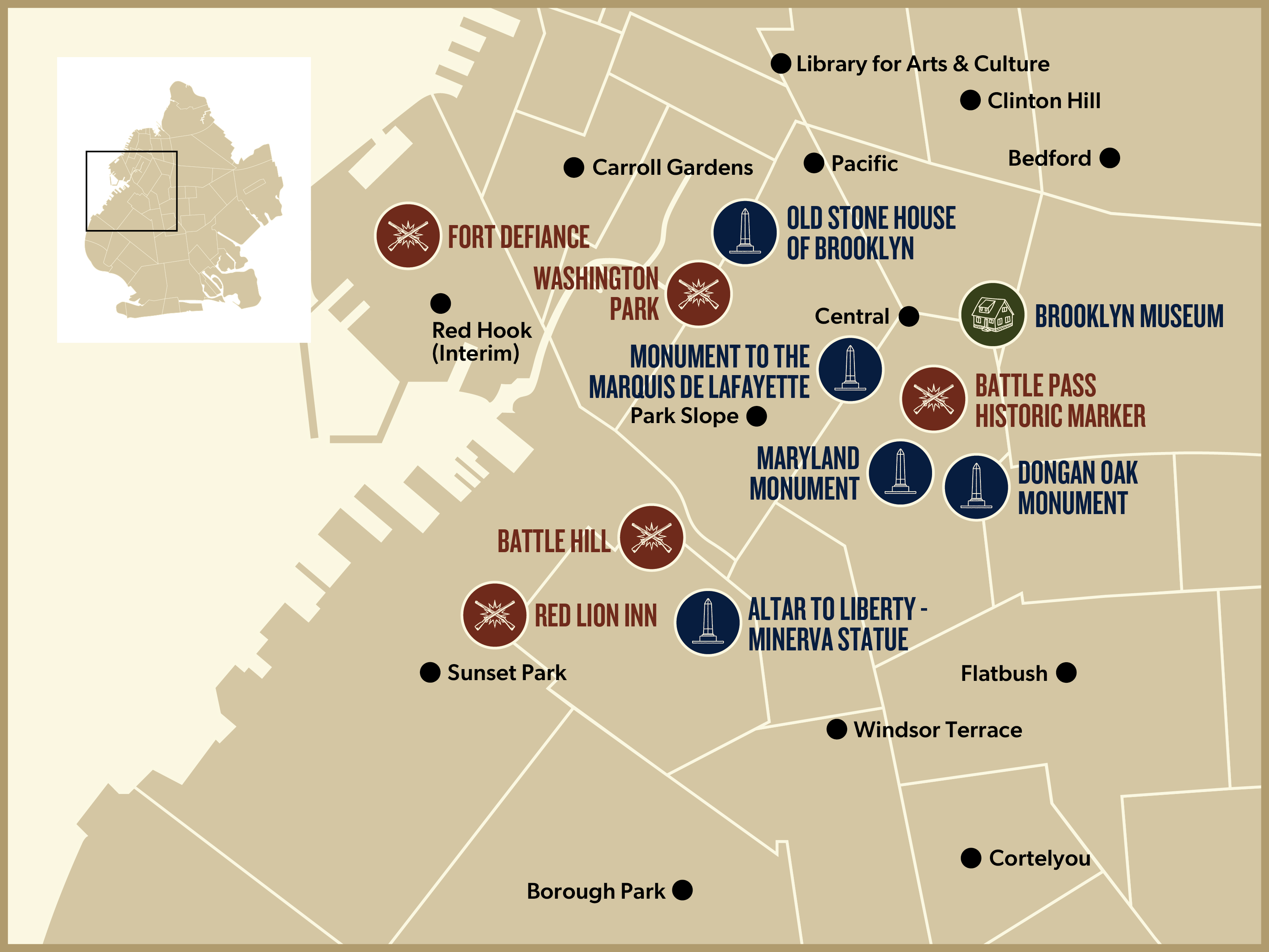
Fort Defiance
Revolutionary War General Nathanael Greene constructed the original Fort Defiance in 1776 in preparation for an imminent British attack on New York City. Soldiers stationed on Fort Defiance exchanged fire with the British warship H.M.S. Roebuck when the British landed in Gravesend, Brooklyn on August 22, 1776. Learn more about Fort Defiance and view location.
Old Stone House
After the Battle of Brooklyn, the Vechte-Courtelyou house, often referred to as the Old Stone House, fell into disrepair and was gradually buried under landfill as the neighborhood of Park Slope developed. It was rebuilt nearby in 1935, using stones excavated from the original house. Learn more about the Old Stone House and view location.
Washington Park
American soldiers fled British troops’ surprise attack in Battle Pass, eventually arriving at Gowanus Creek (now buried beneath today’s Park Slope). A large regiment of soldiers from Maryland launched a sacrificial strike on the British to allow other American soldiers to escape by swimming across the creek. Learn more about Washington Park and view location.
Brooklyn Museum
The Jan Martense Schenck House was built around 1675 on land seized from the local Canarsie Indigenous community in what is now Mill Basin. Occupied by the British during the war, the house was dismantled in 1952 and reassembled inside the Brooklyn Museum in 1964. Learn more about the Jan Martense Schenck House at the Brooklyn Museum and view location.
Monument to the Marquis de Lafayette
Daniel Chester French’s bas-relief sculpture of Marquis de Lafayette, a French military officer who served in the Continental Army, includes a figure believed to be James Armistead, an enslaved African American who served as Lafayette’s groom (and as a spy for the Americans) during the war. Learn more about the Lafayette Memorial and view location.
Battle Pass
The hills of today’s Prospect Park were the site of heavy fighting on August 27, 1776. Hessian troops (German mercenary soldiers) opened fire on the Continental Army in a surprise attack. American soldiers fled across the Long Meadow towards the Gowanus Creek. Learn more about the Battle Pass Historic Marker in Prospect Park and view location.
Maryland Monument
In August 1895, the Maryland Society of the Sons of the American Revolution donated a 12-foot Corinthian column topped with a bronze cannonball to be placed in Prospect Park. The column still stands in the Park today, close to the exact location of the Maryland soldiers’ last stand. Learn more about the Maryland Monument and view location.
Dongan Oak Monument
During the Battle of Brooklyn, Continental soldiers cut down a large white oak tree to delay the advancing British army. The oak tree had been documented since 1685. The St. Nicholas Society commissioned a monument to the fallen tree, which was dedicated in Prospect Park in 1922. Learn more about the Dongan Oak Marker and view location.
Battle Hill
On August 27, 1776, Washington sent 1,600 soldiers to meet 7,000 advancing British troops atop a high hill, today’s Battle Hill in Green-Wood Cemetery. They faced off in battle formation, for the first time in the Revolutionary War, fighting bloodily for several hours. Learn more about Green-Wood Cemetery and view location.
Red Lion Inn
After landing on the evening of August 26, British troops marched from Denyse’s Ferry in Gravesend towards Martense Lane Pass in Green-Wood Cemetery. British scouts outside of the Red Lion Inn were spotted by American riflemen, who managed to send messengers to alert the Americans before they were captured. The Red Lion Inn stood on the present-day site of Melody Lanes bowling alley. View location.
Altar to Liberty - Minerva Statue
Battle Hill is located in today’s Green-Wood Cemetery. In 1920, local businessman Charles Higgins bought the plot of land as a burial site for his family, and commissioned a statue of Minerva, the Roman goddess of warfare and wisdom, to commemorate the site of the Battle of Brooklyn. Learn more about Green-Wood Cemetery and view location.
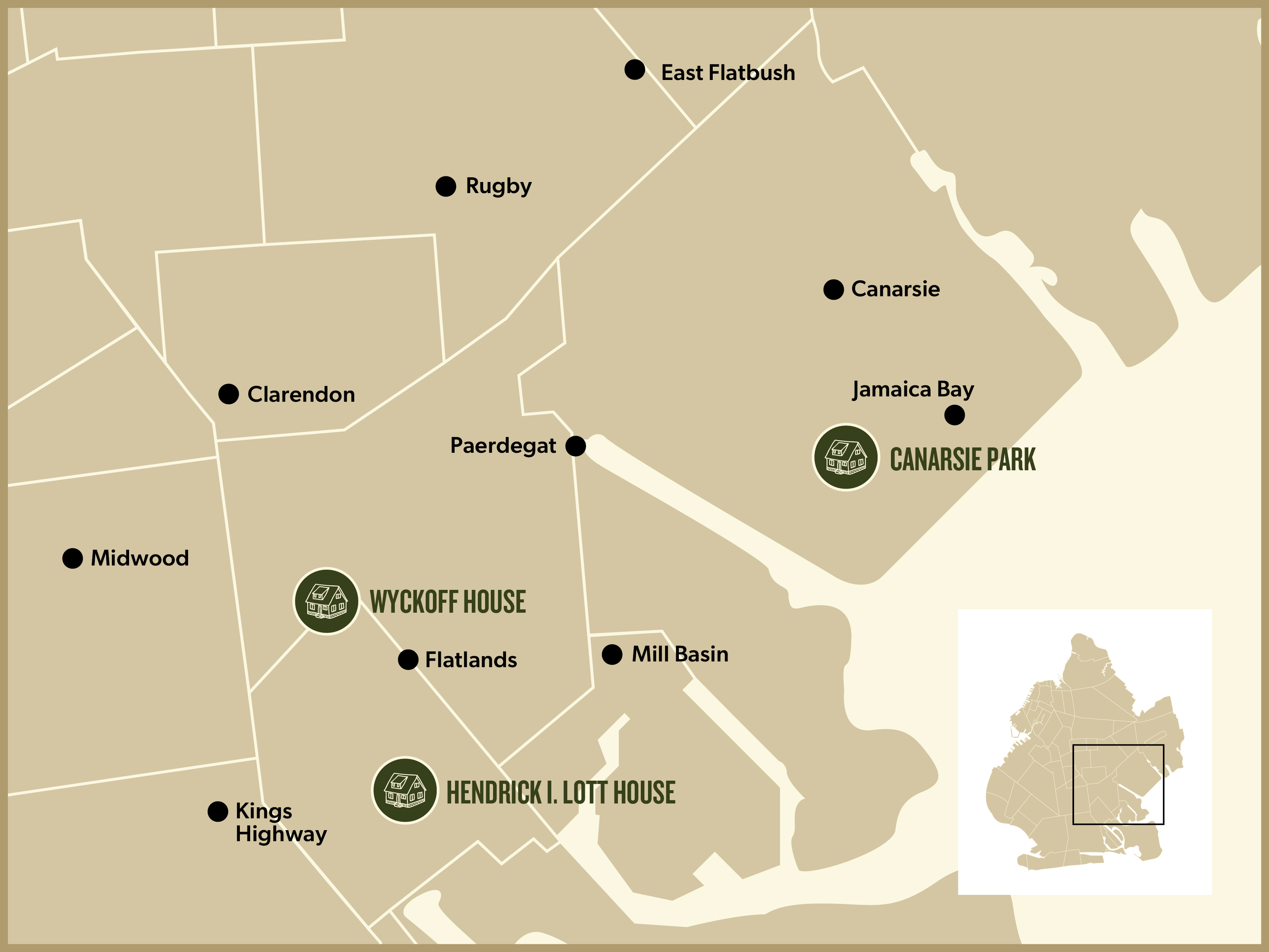
Canarsie Park
Originally called Keskachauge or Kestateuw by the Canarsie Native people, today’s Canarsie Park was once home to Revolutionary War captain Nicholas Schenck, who built a homestead there in the 1770s. In 1929, the Nicholas Schenck House was moved to the Brooklyn Museum, which also houses the Jan Martense Schenk House. Learn more about Canarsie Park and view location.
Wyckoff House
The Wyckoff House is the oldest surviving structure in New York. Pieter Wyckoff moved his family to the house in 1652. At the time of the Battle of Brooklyn, his grandson Peter A. Wyckoff was living there with his young family and the enslaved residents of the house. Learn more about the Wycoff House Museum and view location.
Hendrick I. Lott House
Brooklyn loyalties were split when the Revolutionary War broke out. After the Battle of Brooklyn, during which British soldiers camped on the Lott farm, the Lotts were divided in their affiliation. Johannes Lott remained loyal to the British, while his wife Jannetje personally donated funds to the Patriot cause. Learn more about the Lott House and view location.
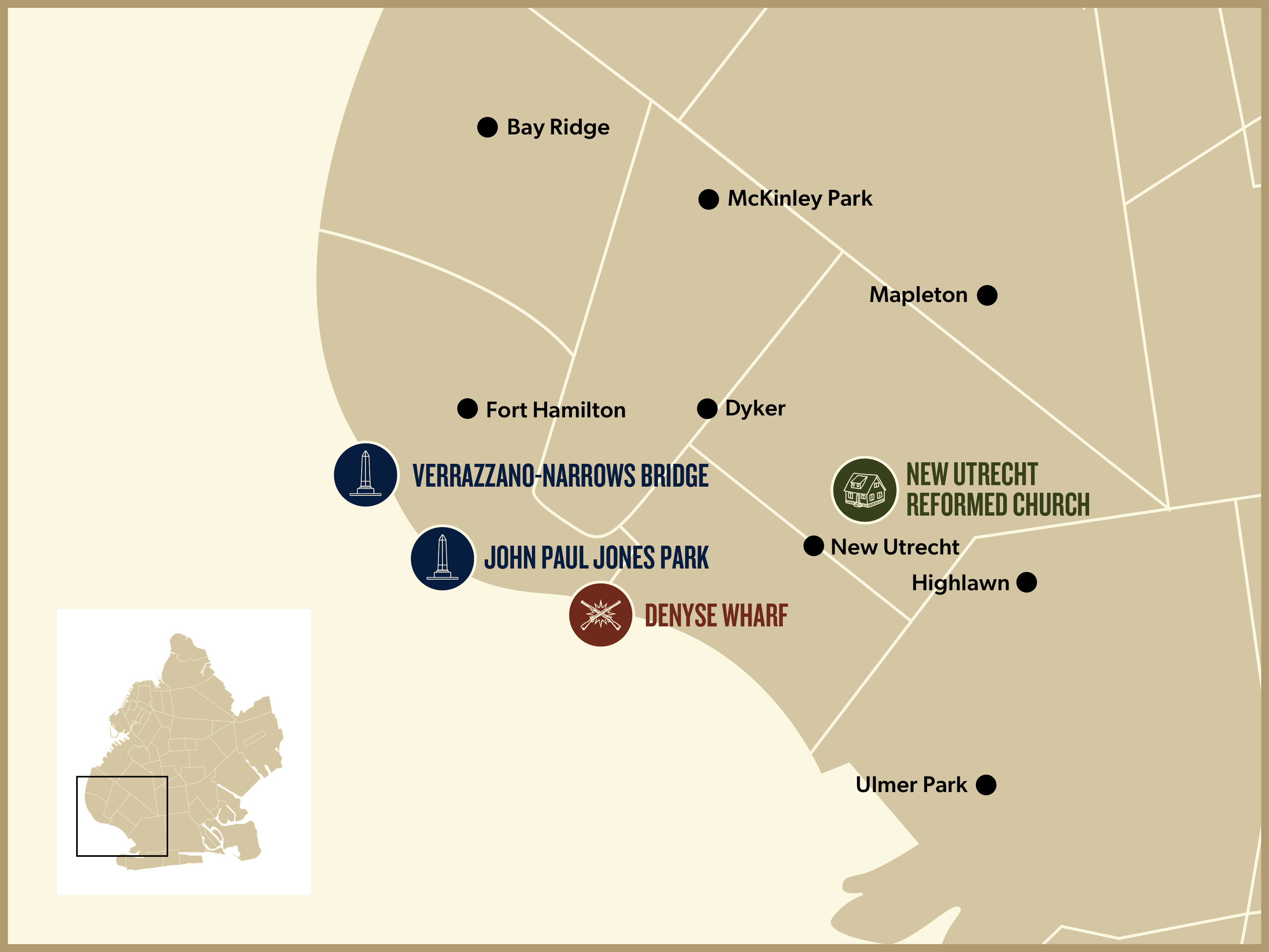
Verrazzano-Narrows Bridge
On July 4, 1976, America celebrated the bicentennial of the country’s founding. Operation Sail brought more than 200 ships through New York Harbor before crowds of hundreds of thousands. After centuries of having been Lenape waterways, these same waters brought Giovanni da Verrazzano to New York in 1524. View location.
New Utrecht Reformed Church
This church congregation was active for nearly a century before the Revolutionary War when the area was still known as New Utrecht. Buried in the church’s graveyard is Egbert Benson, whom George Washington appointed to coordinate the evacuation of British Loyalists in New York City following America’s victory in the war. Learn more about New Utrecht Reformed Church and view location.
John Paul Jones Park
John Paul Jones Park is located near the British troops’ arrival point during the Battle of Brooklyn. Named for Revolutionary War naval commander John Paul Jones, it is also known as “Cannonball Park” for the Civil War era cannon and cannonballs on display throughout the green space. Learn more about John Paul Jones Park and view location.
Denyse Wharf
On the morning of August 22, 1776, a fleet of British ships descended on Gravesend Bay, where today’s Verrazzano-Narrows Bridge connects Brooklyn to Staten Island. An American soldier, awed at the sight, wrote, “I thought all London was afloat.” View location.
This blog post reflects the opinions of the author and does not necessarily represent the views of Brooklyn Public Library.
Post a Comment
While BPL encourages an open forum, posts and comments are moderated by library staff. BPL reserves the right, within its sole discretion, not to post and to remove submissions or comments that are unlawful or violate this policy. While comments will not be edited by BPL personnel, a comment may be deleted if it violates our comment policy.
eNews Signup
Get the latest updates from BPL and be the first to know about new programs, author talks, exciting events and opportunities to support your local library.