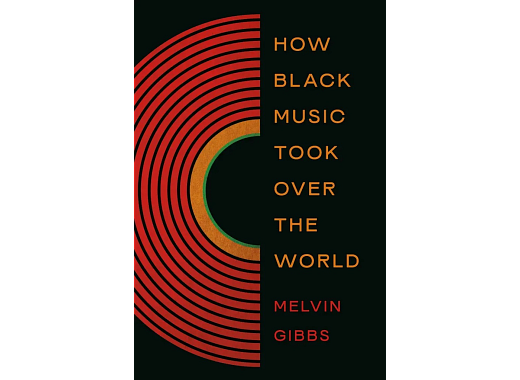
"How Black Music Took Over the World" with Melvin Gibbs and Stephon Alexander
Join FourOneOne and Sound+Science in celebration of producer, bassist, and author Melvin Gibbs’ new book How Black Music Took Over The World, which will be published by Basic Books on April 14th. Gibbs will be in conversation with Stephon Alexander, theoretical cosmologist, jazz musician, and author of The Jazz of Physics and Fear of a Black Universe. This event kicks off FourOneOne’s multipart residency with Gibbs, which explores the themes of the book through a series of conversations and live performances.
The evening will begin at 7:30pm with doors opening at 7pm. We’ll open the night with a short, special performance by Melvin, after which he’ll be joined by Stephon Alexander for conversation.
In How Black Music Took Over the World, Gibbs discusses the musical inheritance of Africa. Beginning with two rhythmic building blocks he calls the cell and the frame, Gibbs shows how those tools can transport listeners to “a realm where sounds become vehicles for human movement.” Reforged in the African diaspora in the Americas, they are played today on church organs, electric guitars, computers, telephones, or a simple gourd. Kool & the Gang called Black musicians the “scientists of sound”—and Gibbs shows how they discovered the world’s music.
Publisher’s Weekly has called the book “a stimulating take on the complexities and influence of a rich and multifaceted musical tradition.” The Brooklyn Rail wrote, “it is an illuminating and comprehensive story. It is great Black musicology.”
Long time friends and collaborators, Gibbs and Alexander co-lead the musical group God Particle. Taking inspiration from the Philip Glass Ensemble’s explorations of scientific themes, Gibbs has also sought creative and scientific advice from Alexander on a series of extended musical compositions. The newest of these works, Nzambici, will be performed in June by Kulunga Sound Ensemble, a group of creative musicians selected by Gibbs and Alexander, as part of Gibbs’ residency with FourOneOne.
PARTICIPANTS
 Melvin Gibbs is a Grammy-nominated composer, musician, and writer born and raised in Brooklyn, NY. Time Out New York magazine once wrote that he was "the greatest bassist in the world” and Jazz Times rated him No. 1 Electric Bassist in their Critics Poll in 2019. His latest album “Amasia: Anamibia Sessions 2”, released this past October, was recognized as a “Best of 2025” release by The Wire Magazine and The Quietus. Pitchfork Magazine called the record “a triumph”. They described the album as “a dynamic amalgam of avant-club music, post-vaporware prog, and electrifying prog”, in contrast to his previous record “The Wave: Anamibia Sessions 1”, released in 2022, which they described as “abstract low-end rumblings somewhere between Thomas Koner’s 1990s gong experiments and Sunn O))) at their most subterranean”. Melvin’s first book “How Black Music Took Over The World”, will be published by Basic Books on April 14th 2026.
His diverse musical background includes mentorship by Ornette Coleman and Gil Evans, stints in Defunkt and the Rollins Band, collaborations in ensembles including Power Tools alongside Bill Frisell and Ronald Shannon Jackson, the cooperative Harriet Tubman and the band Body Meπa, as well as work with Sonny Sharrock, David Byrne, dead prez, Caetano Veloso, Eddie Palmieri DJ Logic, and Arto Lindsay. Within the last few years, Gibbs has released solo works on Hausu Mountain Records, Editions Mego and Northern Spy Records, performed in collaboration with Wadada Leo Smith, Moor Mother, and Marshall Allen, and maintained an ongoing musical collaboration with theoretical physicist (and “The Jazz of Physics” author) Dr. Stephon Alexander named God Particle.

Stephon Alexander is a theoretical physicist, musician and author whose work is at the interface between cosmology, particle physics and quantum gravity. He works on the connection between the smallest and largest entities in the universe, pushing Einstein’s theory of curved space-time to extremes, beyond the big bang with subatomic phenomena.
Alexander is a professor of physics at Brown University who is the former president of the National Society of Black Physicists. He had previous appointments at Stanford University, Imperial College, Pennsylvania State University, Dartmouth College and Haverford College. Alexander is a specialist in the field of string theory and cosmology, where the physics of superstrings are applied to address longstanding questions in cosmology. In 2001, he co-invented the model of inflation based on higher-dimensional hypersurfaces in string theory called D-Branes. In such models, the early universe emerged from the destruction of a higher-dimensional D-brane, which ignites a period of rapid expansion of space often referred to as ‘cosmic inflation.’ He also co-pioneered a modified theory of general relativity based on Chern-Simons theory. This Chern-Simons general relativity has applications in gravitational wave physics, cosmology and astrophysics.
In his critically acclaimed book The Jazz of Physics, Alexander revisits the ancient interconnection between music and the evolution of astrophysics and the laws of motion. He explores new ways music, in particular jazz, mirrors modern physics, such as quantum mechanics, general relativity and the physics of the early universe. He also discusses ways that innovations in physics have been and can be inspired from ‘improvisational logic’ exemplified in jazz performance and practice. Alexander is also a professional touring jazz musician.
FourOneOne is a non-profit organization that centers performance as the embodied means of transmitting the experiential knowledge of communities across generations, geographies and social boundaries. Through concerts, talks and listening events, we support performance practices rooted in the histories and lived realities of communities across the globe, whether from South Asia, the Caribbean, East Asia, North Africa, Latin America, Chicago's South Side, or the Bronx.
Sound+Science is an innovative after-school program, research lab, and community in NYC for high school students interested in exploring the unique and deep connection between music, science, and technology.